Showing posts with label "marathon & beyond". Show all posts

Thursday, August 01, 2024

Afterlife - What do you do now?

This article appeared in the Nov/Dec 2012 issue of Marathon & Beyond


 Afterlife

You’ve Just Completed Your First, Fifth or Fiftieth Marathon.

What Do You Do Now?


By Dan Horvath


Never again.” If you’re a marathoner, it’s more than likely that you’ve uttered those exact two words. Whether you’ve achieved your goals, failed miserably, or fell somewhere in between, it’s natural to have a letdown after you finish. This is the case whether you had other races planned, or hadn’t thought at all about any future running. There are a few who land on their feet, and can’t wait to start training for their next one, but for many to most of us, “never again” is the first thought that occurs to us as we cross that finish line, at least some of the time. It takes some period of time, be it hours, days, weeks, or longer, before we begin to think about what comes next. What comes next is, however, pretty important for the future of your running career.


This article first occurred to me when a friend finished her first marathon, doing quite well in the process, and proceeded to ask me, “What do I do now?” When I began to think about just how important the answer is, it occurred to me that this is something that all of us should consider.


So this is all about rest and recovery, as well as post-marathon goal setting and planning. It’s about taking stock of your achievement, and then striving to improve, or setting some different goals and developing a plan to achieve them.


So now that you’ve crossed that finish line, here’s what you need to do:


Rest and Recover


This is job one. No matter how you did during your race. No matter how soon your next race will be. No matter how you felt during the race. No matter how you feel once you’ve finished. The marathon has beaten you up to some extent. You simply must recover.


If you ran strong and finished strong, you’ll need some rest, but perhaps not as much as if you crashed and burned. If your finish, final miles, or even entire second half conjured thoughts of the Bataan Death March, you will need to take more time off afterward. One rule of thumb is to take as many days to recover as there were miles in your race, so about a month of recovery time is reasonable. This may, but doesn’t necessarily have to mean, no running for 26 days. You should, however, at least have the attitude that you are in recovery mode for that length of time. Here are some additional thoughts about rest and recovery in terms of a timeline.


  • Within one hour after your finish:

    • Walk. Walking immediately after finishing helps stretch your strained muscles just a bit, and helps your body to cool down gradually – a good thing.

    • Drink. Most runners will be dehydrated after a race, and need to drink water or a sport drink afterwards. A smaller percentage of runners will be in danger of hypnotremia, a dilution of sodium in the bloodstream and definitely should not drink afterwards. There is a wealth of information about hypnotremia that will help you determine whether you may be susceptible to it.

    • Eat. As with any hard endurance effort, your body needs some amount of carbohydrate and protein as soon as possible in order to begin rebuilding torn or strained musculature. Eating something within 15 minutes of finishing is recommended, but any calories within the first hour will be helpful.

    • Stretch. But do so very gently! This will also help your muscles recover.

    • Soak. What if I told you that there’s a way to immediately reduce inflammation and jump-start recovery of your worn leg-muscles without using drugs? Soak your legs in water as cold as you can stand. In 2005, I participated in the Tahoe Triple, three marathons in three consecutive days around Lake Tahoe. I learned that soaking one’s legs in the 39F lake water right after each run was de rigour to enable recovery for the next day’s big effort. If you can’t manage to find a body of cold water right after the race, do so as soon as possible.

    • Get massage. These are available in the finish area of many races. Although these 10-minute variety massages aren’t as thorough as the one-hour types, they can help smooth out your tired muscles. Don’t plan on being able to get back off the table easily afterwards.

    • Celebrate. In any way you feel is appropriate. You’ve earned it.

  • Within one day after your finish:

    • Drink. You will most likely be dehydrated for a while. If you’re not in danger of hypnotremia, keep right on drinking.

    • Eat. You need additional protein and carbohydrates throughout the 24 hours following the race in order to continue rebuilding your strained muscles. Especially protein.

    • Walk. Don’t run, but go for a walk the following day.

    • Stretch. But do it gently.

    • Soak. Another bath in the evening of the race will also be helpful as well as soothing. This one doesn’t have to be in cold water!

  • Within one week after your finish:

    • Walk. Walking will still be helpful in the days following your race.

    • Stretch. Stretching will also be helpful in the coming days.

    • Get massage. After a couple days, it’s time for a good massage. It’ll do wonders. You’ll feel human again.

    • Run. Yes, unless you’re injured or have time off planned, you can try to run again. But do it gently. Remember the recovery rule. So no speedwork or high mileage, thank you. By the time the following weekend rolls around, depending on how you finished (see above) you may feel good enough to run hard again. Resist. Yes, you may have another race scheduled (see below) at some point, but if at all possible, you should still take it easy.

    • Cross-train. Gently. Easy cycling, swimming, even easy strength training will actually help speed your recovery. It may even help you feel like you’re not a total slouch (don’t worry: you aren’t anyway – you deserved that rest).

  • Within one month after your finish:

    • Get massage. A second one a week or two after the first one will be helpful as well.

    • Run. After a couple weeks you can tentatively begin running hard again.

    • Cross-train. You can gradually get back to the levels of these activities that you were at prior to your race. You’ll likely find that your fitness in these areas will come back faster than your running.


That’s what most of us should do. What if you have another race in a month, a week, or, for the truly insane, a day? You should still follow the ideas outlined above as much as possible. You may just need to temper the ‘within one month’ plans.


Bear in mind that you are extremely susceptible to illness and injury and during this recovery period. Your immune system has been stressed, so you will not be able to fight off cold, flu, or other infections as well as before. It’s best to avoid possible contact with sources for such diseases by taking additional preventative measures. Likewise, injuries are very common among runners who have recently completed a marathon and who have begun running again. Your entire musculoskeletal system has also been stressed and by running too hard too soon afterwards, you’re at risk of bringing on a new injury.


The rest and recovery information noted above is about the physiological aspects of your post-marathon period. Psychological aspects can be just as important. The initial euphoria may wear off rather quickly, giving way to a let down, possibly even depression. The marathon, including the planning, training, and the execution of the event itself, was a huge part of your life for a long period of time. Now, suddenly it’s over. As we said right off the bat, what do you do now? Most importantly, devote the time and effort that you spent preparing for your marathon on something else that’s important to you. This may also be running-related, such as volunteering at a race or concentrating on some other type of event or distance. Or perhaps some aspect of your life, such as time with the family or friends had been slightly neglected during your race build-up. Now is the time to devote more of your time to those parts of your life.


Do a Post Mortem


You’ve run a marathon. Even in this day and age when lots of other folks are doing so, there are still billions who aren’t. It’s a great accomplishment to complete such an endeavor, no matter how you look at it. That said, we need to note that we are going to feel much better about some of these efforts than others. Someone who reaches a long-standing goal of, say, qualifying for Boston, breaking three or four hours, placing well, etc. may be quite ecstatic afterwards. Those who crash and burn, or otherwise miss a time goal by a little or a lot may not be quite so happy with their effort. The former group ought to go ahead and enjoy their celebration, while the latter group should take solace in the fact that they’ve still accomplished and learned a great deal. This advice is coming from someone who misses his goals extremely often.


After a day or two your head will be relatively clearer and you can be a bit more objective about your run. This is the time to truly take stock. Many of us would or should have set three goals for ourselves:

  1. Our “wildest dream”. A goal that appears just out of our reach but is not completely out the question for us. For example, placing in the top three of your age group when the best you’ve done previously was fifth, or perhaps setting a personal best time even when this wouldn’t have been indicated by your training. Anything that exceeds expectations qualifies here.

  2. The standard doable-but-difficult goal. This can be anything from winning the race to simply running a steady pace to making a specific time goal. This is the attainment of exactly what you’ve trained for.

  3. The acceptable goal. This is the bare minimum that you will accept, based on your training and past performances. For most of us, this should be to simply make it to the finish line. For the over-achiever/type A/hyper-intense types, it may be a time goal that’s somewhat slower than the standard-but-difficult time goal.


Now we can ask, how did we do in terms of these goals? And more importantly, how can we do better? Even if you didn’t explicitly set such goals ahead of time, you can still think about your race in these terms. You can often reconcile your effort in such a way that, even if you missed goal 1 or 2, you may have achieved something even greater, although possibly less tangible. Perhaps you learned how to surge late in a race, finished your strongest last 6.2 miles ever, or made a new friend during the run. Take it from someone who is too often too hard on himself – it isn’t helpful to berate yourself for not achieving some purely arbitrary goal. No matter how you did, take gratification in your effort.


Set Your Next Goals


We marathoners are quintessential over-achievers. We’ve taken the simple activity of running, something that is generally very good for us in moderation, and taken it to extremes. Extremes that sometimes border on being detrimental to our well-being. Most of us began running for the health benefits as well as the social and psychological aspects. We’ve taken this to the point where it drives us, and our loved ones, quite mad.


Goal setting for activities after the race is best done before the race. This may involve planning for a second race before you’ve completed a first one, something most of us don’t do. Presumably, you had some kind of goal before your previous race, and you at least, say, completed the race. Now it’s time to set or adjust your goal(s) for your next one.


The most important considerations are your own aspirations. If you said “Never again”, and still mean it several days or weeks afterwards, then by all means don’t plan on any future marathons. Do plan on running, and perhaps racing other distances again someday, however. Remember: the running part is good for you.


Time goals are the easiest to reconcile; you either made it or you didn’t. On the other hand, it’s been said that the clock will be your most implacable opponent of all. It becomes excruciatingly clear whether you’ve met a time goal or you didn’t. Placing and other goals are a bit more difficult to quantify. Perhaps you may have wanted to win a small race, but then noticed that Paul Tergat and Paula Radcliffe had unexpectedly shown up at the start line. This would be a good time to consider your second or third tier goals. But back to time, by way of example:


Lets say that you had a time goal for the race you’ve just completed. One might be to qualify for Boston with a 3:40 or better, while another may be trying to break three or four hours. Based on your training and the timing of the previous race, let’s say you thought that you could do it. Perhaps you were in the shape of your life. Assuming you finished, there are three possible outcomes for the race just completed:


  1. You exceeded your time goal! All you need to do now is to determine if you are willing to place the time and effort into further improvements, or simply assume that you’ve done the best you’ll ever do, and set your goals accordingly. Changing your goals completely is worth consideration now – instead of a time goal – maybe you’ll want to place higher. Perhaps you’d like to concentrate a different type of event.

  2. You barely missed your time goal. This means you performed almost as expected and were on the right track. Many of us have been there: you were right on pace through, say mile 21, but then the fatigue caught up with you and your pace slowed. You probably need to only tweak your training to enable stronger finishes or to correct other problems.

  3. You were much slower than your time goal. Even in this instance, there may have been extenuating circumstances such as terrible weather, illness or last-minute injury. If, however, there were no such circumstances, you may need a dose of reality. Perhaps your training wasn’t as solid as you had thought. Can you train better without undue risks? Or perhaps this time goal simply isn’t for you; some people will never be able to run a marathon in that specific time, period.


Create a Plan


One of the important considerations in planning your future running is the timing. Assuming that you do want to run another marathon some day, when should that day be? Now that you’ve completed your marathon, done a post-mortem and set your next goals, it’s time to create, and then execute a plan. Do you need to improve fitness by increasing volume or intensity, maintain your fitness level or simply avoid injury? Your plan needs to account for it.


Training plans are ubiquitous. Most are quite good, and work for a variety of different runners. You need to pick and/or create one that will work for you, as well as fit into your timing schedule. To help your planning, reflect on such sources as “Daniels’ Running Formula-2nd Edition” by Jack Daniels, “Advanced Marathoning” by Pete Pfitzinger and Scott Douglas, or Hal Higdon’s Marathon Training Guide at www.halhigdon.com. Other options are to employ a coach (live or online) or to simply design your own. To help you with fitting your training plan into a schedule, I’ve fashioned some for your consideration.


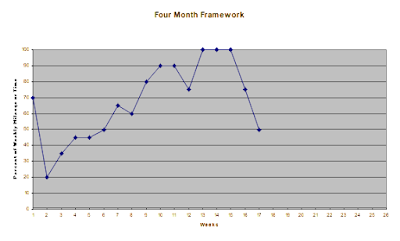
The schedules are not full-blown training plans. They are the timeframes with mileage guidelines for your training plans. In terms of percentage of maximum weekly mileage or time, the schedules will give you a framework around which to build your plan. They all show a dip in mileage after your recent marathon and then the build-up for your next one. The difference between them is that the dip is shorter, and the build-up is steeper for the four and two month schedules. To use them, first determine the highest amount of miles or time spent running per week that you plan to achieve during the training for your next marathon. Multiply this by the percentages along the x-axis, and create your schedule.


Six-Month Framework: Two or fewer marathons a year – perhaps one in the spring and one in the fall - work best for most marathon runners who seek optimal performance. Allowing five or more months between these efforts gives you the time you probably need to recover before beginning a 16 to 20 week training plan.


Four-Month Framework: Say you complete a marathon in May, and want to do another in September. Bear in mind that the shorter the recovery period, the higher the risk of injury.


Two-Month Framework: You run one marathon, and then need to recover, build up your mileage back up and taper for your next one, all within about nine weeks. Now we’re getting really risky, so proceed with caution.


Other Frameworks: Those of us who’ve rattled our brains from running too much may try to run a second marathon less than two months after the first. Some of us may even run them a couple weeks apart, or, for something like the Tahoe Triple, only a day apart. Try scheduling rest, build-up and a taper for that scenario. The truth is that you won’t achieve optimal performance as well as have the least risk of injury with anything less than five months time between efforts. This is not to say that you shouldn’t run marathons more often; if you want to, go ahead and have fun doing so.


Executing Your Plan


Lance Armstrong was interviewed immediately after the 2005 Tour de France and was asked what he would miss the most in retirement. He probably thought about the competition, the camaraderie, the overall excitement. But after a moment’s thought, he said something that was somewhat surprising. He said, “I’ll never be in this kind of shape again in my life, and I’ll miss that the most.” When you think about it, this is a profound and telling statement.


When you do start training once again, don’t expect to be at the same level of fitness that you were in during the build-up for your marathon. Even if the time lapse between your race and your resumption of training is short, you will notice that you can’t run quite as fast, long or hard as you used to. This reduction in fitness should have been built into your new plan, and should not come as a surprise. Have confidence that your fitness level will indeed return to, and perhaps exceed, the previous levels.


Since you’re starting over to some extent, you may actually find yourself thoroughly enjoying the experience of running again. Whereas it may have seemed like work whilst in the midst of your hard training, it’s now become fun again. There is something quite liberating about running with drastically reduced expectations. Feel free to enjoy the experience as you did when you first began running.


Tuesday, July 02, 2024

How Long Should Your Long Run Be, and Other Questions

This article first appeared in the March/April 2005 edition of Marathon & Beyond.


How Long Should Your Long Run Be, and Other Questions

It’s Your Important Training Element – Are You Doing it Right?

by Dan Horvath


It’s been called the cornerstone of marathon training. It’s been called the Marathoner’s “Bread and Butter”. Most succinctly, it’s been called the Most Important Marathon and Ultra Training Element. ‘It’, as you may have guessed, is the long run. Nearly everyone agrees that long runs need to be done. The only question is how.


‘How’, of course, is actually more than one question. How long? How fast? How many? And those are just for starters. Should the pace be steady? Should long runs be weekly? What is the best surface? The list goes on. Of course what you want to know most of all is, what will work best for me?


Why Run Long?


You won’t find too many marathoners or ultra-marathoners that don’t do long runs. Coaches, running authors and other experts recommend them for all runners, but particularly for those training for 26.2 miles or more. Most of us accept the efficacy of long runs almost without question. But let’s ask it anyway: why should we run long?


The most important reason is this: training is specific. It’s just like your mother told you: if you want to be good at something, practice, practice, practice. You are not going to become a world-class sprinter by jogging 70 miles per week, on roads, at a conversational pace. And you’re not going to reach your potential in the marathon by not running those long distances in training.


The human body’s ability to adapt is truly amazing. Long runs “teach” your body to store and use glycogen appropriately, process and eliminate lactate efficiently, and operate efficiently even while slightly dehydrated. Important bodily operations, such as bladder and bowel functions, learn to adapt as well. Perhaps the most important thing your body learns is how to stay on its feet and continually move forward for an extended period of time, staving off muscle fatigue as much as possible. Remaining vertical happens to be a critical success factor for marathons and ultras.


Long runs also train your brain. Your mind becomes accustomed to the rhythm of your stride over a matter of hours, as opposed to minutes. You gain confidence in your ability to perform in the race itself.


There is yet another reason to run long, although not all runners would necessarily agree. But they should. Long runs are fun! Whether it’s alone, in pairs, or as part of some larger group, a long run can actually be a joyful experience. Running for three hours can have an almost dream-like quality. Just think: you’re away from work, your computer, the tube, games, music (usually), and most of all, the demands of other people, for two or more hours. Assuming you’ve found a reasonably quiet, safe place for your running, you may also be able to avoid traffic, noise and pollution as well. Opportunities for such solitude outside of running are quite rare these days. And the icing on the cake is that you’re doing something you enjoy, and derive benefit from, the whole time!


How Far?


Just what is a long run? And, more specifically, how long should your long run be?


To answer the first question, we have to be a bit arbitrary. We could say that a person’s longest run of a given week is a long run. But while 10, 12 or 15 miles may be the longest weekly run for many who are in the early stages of their training, nearly all marathoners and ultra-marathoners ought to include runs longer than that during their latter training stages. With this in mind, let’s pick 18 miles as the minimum distance for a long run. It’s greater than the distances noted above, and most runners will perform their best if their training includes runs of 18 miles or more.


To satisfy the needs of slower runners, and those who run strictly by time, let’s add a time measurement to the definition. To run 18 miles at a 9 minute per mile pace would take 2 hours, 42 minutes. So arbitrarily once again, we can suggest that long runs are either 18 miles or more, or 2 hours, 40 minutes or more, whichever measurement is less. Thus runners doing 9 minutes per mile or slower can say that they’ve done a long run after 160 minutes on the road, while faster runners might call anything 18 miles or more a long run, even if they’ve covered the distance in 2 hours and 15 minutes.


The question as to how long your long run should be is the more important one. It’s best answered by asking other, more pointed, questions.


What are you training for?

An ultra runner who has a 100 miler coming up will want to put some very long runs out there. Six to eight hour trail runs are not unusual. Most marathon runners should complete their long runs in less than four hours.


Where are you in your schedule?

Most runners schedule a peak in mileage, speed, and long run mileage about 4 to 5 weeks before their event. For middle of the pack marathoners, you may want to work up to a long run of 18 miles early on, and then increase it to 22 or so with about 4 weeks to go.


How much can you handle?

Some runners, even some very good marathoners, simply cannot run too many miles without breaking down. In addition, you need to save something for your mid-week running. Everyone handles the recovery from long runs differently. It would be safe to say that you should run as long as you can, while recovering enough to be able to run strong again in another 48 hours.


Have you been hitting the wall?

If your longest long runs have been in the 18 to 20 mile range and you’ve been hitting the wall around the 20-mile mark during your marathons, this may be telling you something. Consider increasing the length of your long runs to 23 or so, within the context of some of the other questions explored in this section.


How many weekly miles are you doing? If your mileage is in the 35 miles per week range and you plan to do a 25-mile training run without increasing overall mileage, that leaves only 10 other miles for your mid-week training. So 25 may be a bit much. On the other hand, if you’re doing 140 miles a week, and your two-a-day schedule never lets you run more than 15 miles at one time, your long runs may possibly be too short. For less extreme cases, let’s devise another arbitrary rule of thumb. Let’s say that for most runners, your long run should be between 25 and 35 percent of your weekly mileage. An 80 mile-per-week runner running a 20 miler is in the 25% range, while a 55 mile a week runner doing that same long run is near the 35% range. The 35 and the 140 mile per week runners will, be outside this range, so some modifications may be necessary.


How long should you be on your feet?

One rule of thumb has been to run as long, time-wise, as you expect to for your marathon. If you’re planning on a 3:16 (7:30 pace) marathon, your longest long run would be 3:16 at perhaps an 8:30 pace (about 23 miles). Slower marathoners and ultra runners would need to put some kind of reasonable maximum on the amount of vertical time – perhaps 3 hours, 40 minutes for the marathoners.


Which experts do you believe?

Jeff Galloway has long been an advocate for slow training runs of 26 miles and longer. Pete Pfitzinger believes that most long runs should be in the 20 to 22 mile range, with one or two only slightly longer. Joe Henderson agrees with the “run as many minutes as you expect to in the marathon, but slower” philosophy. Jack Daniels believes that upper limits for long runs ought to be 20 to 22 miles for faster runners, and 20 miles for slower runners.


Once you’re well into your training schedule and able to handle long runs in excess of 21 miles, consider alternating long runs with extra long runs. Your long runs may be 20 miles and your extra-long runs may be 23 to 25 miles each. This way you achieve the confidence and strength required for a marathon, but not quite every week, so you’ll still have something left for that mid-week training.


How Fast?


This question is naturally intertwined with that of how far. If you run very far (say, 30 miles or more), you probably can’t run as fast as when you’re keeping your long runs on the short side (say around 18 miles). Conversely, if you run extremely slow, you may not be able cover the distance you need to in a reasonable period of time. It may be fine for ultra-marathoners to spend 6 Sunday-morning hours on the trails, but this may be counter-productive to a fast marathon time.


Galloway, Henderson and several others believe long runs should be at a very slow pace. Many suggest 1 ½ to 2 minutes per mile slower than your race pace. Galloway has espoused the practice of taking walking breaks during long runs as well as during the marathon itself. ‘Gallo-walking’ has proven to be somewhat successful for those without aggressive time goals.


Jack Daniels recommends that long runs should be at an easy pace. Based on recent race performances, average runners’, ‘easy’ pace works out to about a minute per mile slower than marathon race pace. Faster runners should run slightly faster than that, and slower runners a bit slower. Other middle-of-the-road advice comes from Pete Pfitzinger. He recommends that your long run pace be 10 to 20 percent slower than planned marathon pace.


And then there’s Marathon and Beyond’s own Rich Benyo. Remember the part about practice, practice, practice? How can you expect to run all 26.2 miles of a marathon at a 7:30 pace, when all of your long run mileage has been at a 9:30 pace? In this instance, you’ve taught your body to run long distances, but at a much slower pace than you want to go during the race. Benyo believes that long runs should be at marathon pace or slightly faster, and he has incorporated this concept into his training plans. Of course this isn’t easy. And of course there’s a bit of controversy about this. But this approach sure puts the specificity of training concept to the test.


The best approach, of course, is what works best for you. You may need to experiment with all three concepts listed above to determine which is optimal. Consider varying the pace during the run itself. Perhaps you might try breaking the run up into three or four parts and run each at a slightly faster pace until you’re doing the last 5 miles at marathon pace.


Also consider alternating fast and slow long runs. You can incorporate this idea with that of alternating the distance of your long runs. For example, a 3:15 marathoner might run a 20-miler one week at 7:45 pace, and then a 24-miler the next week at 8:30 pace. To take the example a step further, this runner might consider running the last 5 miles of the last 24-miler at her or his marathon pace of 7:30 per mile.


How Often?


For better or worse, most of us adhere to a weekly work and social schedule. For practical reasons, it’s natural to align a training schedule with that social and work schedule. Thus we have weekly speedwork sessions, weekly days of rest and weekly long runs. It doesn’t absolutely have to be this way; some coaches who believe that a long run every 7 days is too often, recommend a ten-day training cycle, with one long run per cycle. But this may not be realistic for those of us who also do non-running work for a living. Some, including Galloway, have suggested that a long run every two weeks is optimal.

Most coaches, however, stay with the weekly schedule. It may make sense to skip a weekly long run on occasion, perhaps substituting a race or speedwork session. So consider skipping the long run in favor of rest, speedwork or a race during one weekend each month.


How Many?


Some runners do weekly long runs all year, even during the off-season. For these individuals, this question becomes mute. The more important questions are, how long is your training period, and what kind of shape are you in at the start of it.


Most training plans are 12 to 18 weeks long, although some are as long as 24 weeks. Let’s say that 16 weeks is typical. Assuming the long runs are to be done weekly, the next question is, when do they start? In other words, at what point in the 16-week schedule will your longest run reach 18 miles? Let’s say that most runners would be scheduled to reach this point by the halfway point. In this case, the runner would do about 7 long runs (weeks 8 through 14), with weeks 15 and 16 reserved for a taper and the race itself. The length of these long runs will vary as noted above. This number could be reduced by one or two for runners who decide to skip a long run or substitute a race.


Some will think that 7 long runs are too many, and others (those all-year weekly long-run types) will think they’re too few. It’s going to vary by individual, but it’s worthy to note that there should be some minimum number of long runs in order to expect a decent marathon performance. Let’s arbitrarily say that the minimum number of long runs that should be done in preparation for a marathon or ultra is four.


How Hilly and How Rough?


Since this is actually several terrain-related questions, let’s examine each one:


Is it better to run on trails, if your goal event is on roads?

Many runners enjoy doing much of their training, and particularly their long runs, on trails. They feel that the surface is easier on the joints, and yet still affords a great and enjoyable workout. Most of the rest of us would derive some benefit by adding trail runs to our regimen. If your goal event is on paved roads, however, remember that training is specific. You won’t perform your best unless you include at least some runs, including long ones, on that same surface. The two main reasons are that you can train faster on roads than on trails, and secondly that your body will get used to the stress of the harder surface.


Is it better to train on asphalt versus concrete?

This one’s easy: asphalt by a mile; by a light-year. Concrete is much too hard a surface, and should be avoided as much as possible for your long runs. What if your goal marathon is on a concrete surface? The best advice would be to pick another marathon. If you still want to do that one, training on asphalt should be as adequate as anything. It would be much better to train on asphalt than concrete for a concrete event because you’ll have had enough hard surface training, yet you will not have had the impact problems that you would have had you run on concrete.


Should you do long runs on a treadmill?

Not unless you have a good movie to watch. Long runs on treadmills are fine, mostly because you’re never far from your starting point, the risk of injury is slightly lower and recovery is faster. You won’t find too many marathons where there is a gentle moving belt under your feet however. As with the trails, you should do at least some of your long runs on the type of surface that your goal event will have.


Should you train on hills if your goal event will be flat? Should you train on hills if your goal event will be hilly?

The short answers are, yes - to some degree, and YES! Hill training will benefit all runners, even those training for a flat event. Hill training is an integral component in many running plans, including those devised by Arthur Lydyard. Incorporating hills into long runs make them interesting, challenging and fun. This should be done in moderation for those training for flat events however. In these cases, it’s especially important to keep the hills moderate for the last few long runs leading up to the event. If, on the other hand, you’re training for an event that you know will be hilly, then you should try to incorporate those hills into your long runs as much as possible. It would even be helpful to include substantial downhill running for downhill races such as Boston.


Putting it All Together


All runners should understand that by making their long runs too long or too fast, they assume the risk of jeopardizing their mid-week training. On the other hand, the more specific a runner’s training is, the better chance he or she will have of achieving his or her goals. It’s an important balance, to make your weekend long runs challenging enough, and yet be able to run hard again by the following Tuesday or so.


Long runs are not to be taken lightly. You are going to be out in the elements and exerting your body for a matter of 2 hours or more. This isn’t easy. Do a mini-taper, and allow time for recovery afterwards. Carbo-load to some extent. Get proper rest before and after. How much you prepare will have a direct impact on the quality of your long runs. And the quality of your long runs will have a direct impact on the quality of your race.


Running long runs with others helps take the drudgery out of them, making them more of a social experience. Gordon Bakoulis Bloch believes that this makes them easier mentally. And for this very reason, Bloch recommends that at least one or two be done solo. This is still another aspect of the need to train your mind.


You can consider substituting a race for one of your long runs, but take care. A half-marathon, 25K, 30K or even a full marathon can be an excellent training device. But remember to keep your eyes on the prize – your own goal race. Run these ‘training races’ at perhaps 90% of effort, so that a speedy recovery is ensured. This is especially so if you’re within 5 to 6 weeks of your goal race.


Oh, yeah. And remember to have fun!


 SIDEBAR – A Long Run Schedule


Most marathoners and ultra-marathoners plan on a 12 to 24 week training schedule, with 16 weeks being most typical. With that in mind, here are long run schedules for runners who average 45, 65 and 85 miles per week. “Easy” speed means about 1 to ½ minutes per mile slower than planned marathon pace. “Brisk” means about ½ to ¾ minutes per mile slower than marathon pace. For those weeks that call for marathon pace running, make sure that you gradually work up to that speed. And if you choose to include other races, take care not to run them too hard.


Week

Long Run Distance- on 45 Miles per week

Long Run Distance- on 65 Miles per week

Long Run Distance- on 85 Miles per week

Speed

1

13

15

15

Easy

2

16

17

18

Easy

3

14

16

18

Easy

4

17

18

19

Easy

5

15

18

18

Gradually increase speed - last few miles at marathon pace

6

17

20

21

Easy

7

16

18

20

Brisk pace

8

19

22

23

Easy

9

18

20

20

Consider substituting a long race

10

19

22

24

Easy

11

18

20

21

Brisk pace

12

20

23

25

Easy

13

18

20

21

Consider substituting a long race. But don’t kill yourself

14

21

24

25

2nd half at marathon pace

15

18

20

22

Easy, but finish at marathon pace

16

10

12

13

Easy

17

GOAL RACE

GOAL RACE

GOAL RACE

Optimal!


 SIDEBAR – What do the elites do?


The elite runners are different from the rest of us. They run faster. What the elites do isn’t always what we should do. But it sure doesn’t hurt to study them. We might even learn something. Unfortunately, not all elites share their training schedules. For those that do, we don’t always have the complete story. Here are a few pieces of information, from both current and ‘old-guard’ runners.


Khalid Khannouchi does about 8 long runs of up to 22 miles during his 16 week build-up. He runs them hard and finishes extremely hard – often doing the last few miles faster than marathon pace.


2000 Olympic Marathon champion Naoko Takahashi reputedly ran up to 80 kilometers some of her training days, but there are more credible reports of runs of 40K at 10,000 feet of altitude. Either way, that’s some running!


Greg Meyer ran 20-mile fartlek training runs on the Boston Marathon course during the weeks leading up to the event.


During his best racing years, Bill Rodgers ran a ‘good quality’ 20 to 23 miler every weekend.


Multiple Comrades Marathon champion Bruce Fordyce believed in doing relatively few long runs as part of his long ultramarathon training schedule. He usually did one 35 to 43 miler, eight 26 to 35 milers and three 20 to 26 milers. Fordyce did do other slightly shorter runs that many would consider ‘long’.


Rob de Castella’s training schedule called for weekly runs in the 20 to 22 mile range. He ran these in times anywhere from 2:15 to 2:40.


For Grete Waitz, training for the marathon was different from training for shorter races only in that the overall mileage was higher, and this was mostly in the form of her long runs. Her long runs were in the 15 to 18 mile range leading up to her marathons.


1972 Marathon champion Frank Shorter ran his long runs in the 20-mile range. He says that he ran the first half of these relatively slowly – at about 6:27 per mile pace, but then did the second half at about 5:00 per mile pace.


 Bibliography


Benyo, R. 1992. Making the Marathon Your Event. Random House of Canada Ltd., Toronto, ON

Benyo, R. 2002. Basic Training for a 3:30 Marathon, Marathon and Beyond, Vol 6, Number 2.

Benyo, R. 2002. Basic Training for a 3:00 Marathon, Marathon and Beyond, Vol 6, Number 3.

Benyo, R. and Henderson, J. 2002. Running Encyclopedia. Human Kinetics, Champaign, IL

Bloch, G. B. 1993. How to Train for and Run Your Best Marathon. Fireside, New York, NY

Daniels, J. 1998. Daniels’ Running Formula. Human Kinetics, Champaign, IL

Galloway, J. 1984. Galloway’s Book of Running. Shelter Publications, Bolinas, CA

Higdon, H. 1997. How to Train. Rodale Press, Inc., Emmaus, PA

Khannouchi, K. 2003. Run Your Best Marathon Runners World, Aug. 2003 pp 80-81

Noakes, T. 2003. Lore of Running. Human Kinetics, Champaign, IL

Pfitzinger, P. and Douglass, S. 2001. Advanced Marathoning. Human Kinetics, Champaign, IL

Pfitzinger, P. 2003. The Pfitzinger Lab Report: Your Long Run Prescription Running Times Sept. and Oct. 2003. pp 12.


The Quiet Explosion in 24-Hour Running

This article appeared in the July/August 2013 edition of Marathon & Beyond. Enjoy.


The Quiet Explosion in 24-Hour Running
When the term “one day” takes on an entirely different meaning.
By Dan Horvath

For most races, the goal is to determine who go run the fastest. This goes for all distances, including marathons and ultramarathons. For those of us in the middle of the pack, it may be more a question of How fast can I run? rather than Can I run faster than everyone else? Regardless of one’s prospects, the elementary nature of the event is still a race to see how fast everyone can get to the finish. In 24-hour and other fixed-time runs, the question changes entirely. The query becomes How far can I run?
    
Happily, running events of nearly all distances are experiencing a great deal of growth, in both the quantity of events and the number of participants. That growth applies to ultramarathons as well. UltraRunning Magazine reports that the number of runners who finished ultramarathon races increased to 52,000 in 2011. This represents an increase of 12 percent more than 2010, and triple the number of finishers of 2001. There are, unfortunately, no known statistics regarding the number of these finishers that participated in a fixed-time ultramarathon.

We can postulate with reasonable certainty, however, that the number of fixed-time ultramarathon races is growing at least as fast as other trail and road ultras. Although no one seems to be collecting overall statistics for these events, some informal information gathering tells us that well over thirty 24-hour runs are now held annually in the US, whereas only a handful existed as recently as just a few years ago. (See the sidebar: A Sampling of 24-Hour Running Events.) The rapid growth, at least in the number of these events, mirrors the growth of the sport of ultrarunning itself.

The word race usually means a contest to determine who can cover a given distance the fastest, and is used rather loosely here. Other than calling the fixed-time races runs or events, there’s simply no other word for them than races. Although we mention other timed events here, this article focuses mostly on the 24-hour variety.

Besides their growth in popularity, these races are also seeing more and more outstanding performances. In 2012, for example, runners broke both the US men’s and women’s 24-hour records. Mike Morton set the men’s record of 172.458 miles, smashing the old record of 165 miles set by Scott Jurek. And Connie Gardner set the US women’s 24-hour record with 149.368 miles, after very narrowly missing the mark several times in past years. Both records were set at the IAU 24-Hour World Championship in Katowice, Poland.

Unfortunately, all of this—the growth and the great running—appears to be happening “under the radar.” Little attention is given to it by running resources. One can say that ultrarunning in general gets little attention, but even so, timed racing gets even less. This dichotomy of high popularity without much attention explains the title of this article.

Mike Morton

Connie Gardner and others


    How Do These Things Work?
    
Fixed-time races come in a variety of shapes and sizes, but they have elements in common. Here are some of the components.

Although 24-hour runs are by far the most prevalent, 6-hour, 12-hour, 48-hour, 72-hour, and even 6- and 10-day timed events are also popular. The combination of a 24-hour run with one or more additional fixed-time events is common. Still, the 24-hour runs are often the marquee events.

The course may be on any surface. Most ultramarathons in the US are run on trails. A quick look at the sidebar list of 24-hour events shows that several of these, too, are on soft surfaces. But many are run on paved roads and all-purpose trails. Some are on 400-meter synthetic or rubberized tracks. The advantage of dirt trails is that the softer surface translates to less impact over the course of a full day of running. The advantage of a paved surface is the potential for improved performance; most runners will be able to cover more miles on a road or all-purpose trail than a dirt trail. Tracks may provide both a softer landing and possible top performances. For tracks, however, the constant turning, the shorter length (which increases traffic and allows for fewer competitors), and decreased scenery add their own challenges.

Many courses are flat. The ones with significant hills are usually the trail variety. Hills inevitably result in less ground covered. Most records are achieved on flat courses. That said, some runners might find that some slight amount of altitude variation on a course provides a benefit of more varied muscle use. 

Runners of fixed-time events usually prefer that the courses contain as few sharp turns as possible. In fact, the fewer and wider the turns, the better. Courses with many of them, such as 400-meter tracks (meaning two large turns per loop, about eight per mile), often call for a reversal of direction at regular intervals in order to reduce the amount of stress runners experience due to the constant turning.

None of this is to say that any particular surface, hilliness, or number of turns is in any way superior to others. Just as fixed-distance roads and trails feature different challenges that affect top or record performances, so do fixed-time courses.

The USA Track and Field Mountain Ultra Trail Council designates one event as the men’s and women’s 24-hour national championship run each year. The top runners from the championship as well as other races are picked to represent the US at the International Ultramarathon Association World Championship. Both the national championship and the world championship are usually held at a venue with a paved surface. The participants want to get as far as humanly possible.

Timed ultramarathons are held on loop courses so the distances can be measured. Runners are scored by their total overall distance achieved within the given time limit. This means they must complete the loop as many times as possible. The distance might be anything from 400 meters to several miles.. Most runners feel that they can achieve their greatest distance on an asphalt (not concrete) paved trail that is at least a half-mile in length, and has no sharp turns or hills. Loops of one mile or thereabouts are the most common. Many races take place within a park or other closed area where traffic control is not a concern.

Timing is a critical component. Of course it is necessary to count the number of circuits for every runner in order to determine their distance. This can be done manually in one of several ways, but in order to track a large number of runners accurately, including their lap split times, required for USATF records, electronic chip timing is practically a necessity. The rapid growth of timed races could not have taken place without the emergence of electronic timing in the past fifteen years.

Race rules vary, but in general, runners may have their own support crews in addition to any aid provided by the race organization. Runners may stop running for aid or even to rest, but the clock, as they say, keeps on ticking.

End-of-race procedures vary as much as the other, more general race rules. In some cases participants drop a marker when the final horn blows, so that they can be given credit for any partial lap. In other cases, an hour or so before the finish time, runners are moved onto a smaller loop area, such as a 400-meter track, and are given credit for the number of full smaller laps, in addition to their previous mileage. In a third scenario, only the full laps are counted regardless of the loop length.

    The State of the Sport 
    
It may surprise you to learn that there is an active and rapidly growing subculture of fixed-time ultrarunning specialists. Arguably, a runner who is capable of running long distances ought to be able to do so over different terrain, whether by running loops or traversing a non-repeating course. And this is indeed the case with many runners, including some of the best. But others, including some of those on the US National Team, appear to do well mainly at the fixed-time variety of ultramarathon. Still others, who may have excelled at trail ultras, have had disappointing results at 24-hour and longer fixed-time runs.

The top performances just keep right on coming. The records set at the 2012 24-Hour World Championships are only the most recent examples. As noted, Connie Gardner had narrowly missed the US women’s record—by less than four miles in 2010 and 2012, and by less than one mile in 2007 and 2011. She was the second overall female at the world championships. Sabrina Moran had set the US mark only a few months earlier in Cleveland. Also at the world championship, US runners Suzanna Bon and Anne Lundblad also turned in great performances, and the US women won the team title.

Scott Jurek had set the previous men’s record at the 2010 24-Hour World Championships, eclipsing Mark Godale’s ten-year-old record. When Mike Morton won the 2012 world championship meet overall, he broke Jurek’s record by an astounding seven miles. The US men, including Morton, Harvey Lewis, and Joe Fejes, scored third in the world behind Germany and France.

At other events, Fejes also ran a monumental distance—over 329 miles—at the 2012 Across the Years 72-hour run. Another US National team member, Phil McCarthy, set the American record for 48 hours of 256.771 miles in the 2011 Three Days at the Fair run.

So yes, American runners are among the best in the world, and they keep getting better. One reason for this is that American fixed-time events are also among the best in the world. Most are well organized, and manifest outstanding attention to detail. Some of the most prominent of them are:
    • 24 The Hard Way: Runners have a choice or running 24, 12, or 6 hours on a dirt trail or a paved path. The event takes place in Oklahoma in October. The 24-hour race will serve as the USATF National Championship in 2013.
    • Across the Years: This Arizona race features 24-, 48-, and 72-hour runs. Depending on their choice of event, runners may be running from New Year’s Eve into New Year’s Day. Operational since 1983 (with a hiatus in 2009), this is one of the longest-running fixed-time events in the country. ATY has a proud tradition and a loyal following.
    • NorthCoast 24-Hour Endurance Run: There are spring and fall versions of this run at Edgewater Park on the shore of Lake Erie in Cleveland, Ohio. It was the National championship from 2009 through 2012, and it will be again in 2014. There have been some great performances over the years, including those of Connie Gardner and Sabrina Moran.
    • The Sri Chimnoy Self-Transcendence 6-Day, 10-Day and 3100-Mile Races: It sounds like a lot and it is. Although the 3100-mile race is not strictly speaking a fixed-time race, it features many similarities to fixed-time races. The Sri Chimnoy family of events, too, have a long and proud tradition and history.
    • Three Days at the Fair: Runs of 72, 48, 24, 12, and 6 hours are featured at the Sussex County Fairgrounds in New Jersey. All events except the 6-hour race finish at 9:00 a.m. on a Sunday morning in May. Runners can also enter marathon and 50K distance races. The US men’s 48-hour record was set here in 2011.

So you think you may want to run one? Not so fast!

The first question is why. For most of us, the answer is something like to see how far I can go. As with any quest, the more specific you can be, the better. You stand a better chance of accomplishing something meaningful if you say to yourself, I want to run 100K, rather than simply, I want to run until I crash. Goals are good because they keep us focused. And focus is definitely something you will want to hone if you’re thinking of tackling a fixed-time race. On the other hand, it’s also important not to set your expectations too high, especially if you’re a first-timer. Many an experienced ultrarunner has underestimated the difficulty of running for 24 hours. For example, an elite ultrarunner may complete a 100-mile trail race in 14 hours, but after 14 hours of a 24-hour run, there are still 10 hours to go. Our hypothetical runner, perhaps used to running for only so long, might simply crash shortly after the completion of those first 100 miles. Despite the fact that, depending on the terrain and surface, one can generally travel for more miles in a timed event than a fixed-distance race, it’s easy to become overconfident. Yet some of the records—such as the ones noted above—are simply phenomenal. They reflect an extraordinary amount of focus and determination.

Fixed-time races are also an excellent opportunity to run a first ultramarathon. While focus and determination are still required, new ultramarathoners may be surprised at what they can accomplish, given enough time.

Fixed-time running certainly isn’t for everyone. Many ultrarunners strongly prefer to run on trails through remote and scenic areas. Loop courses are, in the eyes of some ultrarunners, decidedly more boring and tedious. However, if a runner can master the sometimes mind-numbing effort, he or she may be able to achieve a distance not possible under other circumstances.

Believe it or not, timed events can also be loads of fun. For some, the joy comes from seeing and running alongside all the other competitors during the entire time of the run. Having a crew, perhaps at a campsite with a tent, also adds to the enjoyment. On the other hand, some runners prefer the challenge of supporting themselves without the benefit of a crew. Think of these events as parties where people run, as opposed to races … where people party.

The competitive aspect can be intensely interesting as well. Each runner is often within sight of others who may be rivals. There have been exciting instances where one runner has overtaken another for place, or two top runners have run together nearing the final lap of a 24-hour run.

Nevertheless, there’s still that simple challenge of seeing how far one can go. For many runners, being able to run 100 miles within 24 hours is a great and worthy goal. Mathematically, it doesn’t sound so tough: just average 14:24 per mile. Many people can do this simply by walking fast. And the best chance to accomplish such a mission is most likely a well-organized 24-hour run. But beware—sticking to it gets harder as time goes on. No matter how slow and easy the early pace may seem, things always get tougher late into the night.

Should you go in with a detailed plan, or just run all out until you crash and burn? Framing the question this way makes the answer fairly obvious, but it may surprise you to learn that many runners—even some very good ones—go into fixed-time races without any strategy whatsoever. This is not to deny that some of them have accomplished much by starting out hard and staying with it. But for most of us, a strategy will provide us the best chance of reaching our goal. Many runners employ a race plan that includes walking breaks at regular intervals. And as with runs of any length, pacing oneself, especially in the early part, is of vital importance.

Your chance of success will naturally depend mostly on your preparation. Those who include long distance running, ideally over several years, in their training will have an advantage, but so will those who practice running at various times of the day and night hours, as well as those who practice their pace along with planned walking breaks.

All this serves to answer one just little question. You know the one: How far can you run?


    Sidebar—Resources
    
    • American Ultrarunning Association (AUA): http://www.americanultra.org/
    • International Association of Ultrarunners (IUA): http://www.iau-ultramarathon.org/
    • Multidays website: http://multidays.com
    • UltraRunning magazine website: http://ultrarunning.com/index.shtml
    • iRunFar website: http://www.irunfar.com
    • USATF Mountain Ultra Trail site: http://usatf.org/Sports/MUT.aspx
    • Washington Post article about ultramarathon growth: 
        http://articles.washingtonpost.com/2012-05-23/sports/35458185_1_trail-races-runners-hope-marathons


    Sidebar—Some Timed Races