Friday, December 24, 2021

YMMV (Your Mileage May Vary)

Another article I wrote for Marathon & Beyond required a great deal of analysis and effort. But the result is one of my favorites. I also received a whole lot of feedback about it, mostly good. There was even a reference to it in Runner's World. So from the January/February 2002 M & B, here is YMMV.


YMMV (Your Mileage May Vary)

The Quest to Determine the Most Relevant Training Elements Begins with Examination of One Runner’s Data

by Dan Horvath


Auto manufacturers are careful to qualify their gas mileage claims with the phrase, “Your mileage may vary”. And so it is with distance running as well. What works for one person may or may not work for another. There will be varying degrees of correlation between one runner’s training regimen and his or her results and those of another.


One of the problems in determining how best to train for and run marathons is that there are so many varied opinions about what works and what doesn’t. Every coach and writer has his or her own biased views about what you ought to do to maximize your training and realize your potential. Unfortunately, much of this is not backed up by hard evidence. In many cases, the data required for adequate analysis simply does not exist.


Over the years, I’ve been collecting an extensive amount of data about my own training and racing. Although this data applies only to myself, and your mileage may vary, some analysis will still be useful to others. At best, you may be able to apply some of the deductions to your own training. And at the very least, you will be able to find out what has worked or not worked for this one individual.


Based on the analysis of the data, we will be able to examine the following:


  • Correlation between overall training factors (such as total mileage, overall pace and mile repeat pace) and marathon performance

  • Correlation between various long run factors (such as long run pace and distance) and marathon performance

  • Correlation between various other miscellaneous factors (such as weight and age) and marathon performance


These elements were chosen for two reasons: first, they may actually provide useful information, and second, I actually have data relating to them.


The Data


In order to determine which training elements have the most influence on a given race, we must first select the marathons, and then the related training in which to study. Here are the criteria for choosing which of my 50+ marathons to include in the analysis:


  • There must be data available relating to all of the factors noted.

  • The marathon itself must have been a serious effort, not just a “long training run”.

  • I must have not become injured or sick just prior to, or during the race.

  • I must not have “hit the wall” badly during the race. This is because these efforts are generally precipitated from starting out too fast, and then finishing with a much slower time than I would have had, had I simply run a steady but slower pace.


In other words, I was interested in the races where I would and should expect a certain result, based as much as possible on the training itself. I came up with 30 races that fit the criteria.


It so happens that for many of these marathons, the expected result was a time in the neighborhood of three hours (for more on how to break 3 hours, see “Six Fifty-Two” in the November/December 1999 issue of Marathon and Beyond). Some of these efforts were successful and some not. For the purposes of this study, however, that objective shouldn’t matter. The correlation between the various training elements and the marathon performance ought to apply regardless of the time goal.


Several environmental factors, such as weather conditions, and what one ate the night before the race, may cause variation in marathon performances. Using larger quantities of data help to mitigate these in such a way that they begin to lose significance, however. They will not be taken into account for this study.


Most marathon training programs span a time period of 12 to 18 weeks. Although a longer build-up period is generally preferable, often the first several weeks are devoted to base building. The specific factors to be studied here assume that the subject already has a solid base, so the period chosen for the data is generally one of 12 weeks prior to the marathon.


Information, Correlation and Causation


Although I’ve collected all of this data, I haven’t always done so great a job of processing it into useful information. Sure, I do look back once in a while to determine some of the training that lead to a successful race effort. But these looks back are not very qualitative or quantitative. A detailed analysis at the data is the goal of this exercise. The transformation of the available data into useful information involves correlating the training data with the marathon performance data by use of statistical methods.


Probability and Statistics were not among my strongest courses back in my college days. Those days, in turn, happen to be a long time ago in a galaxy far, far away. I am fortunate, however, to have two daughters in college who were able to help their dad out with his “homework”. You won’t need to be a statistician to understand the basic principals here, however.


To show correlation, each set of training data is plotted against the marathon performance data. In addition, a correlation coefficient, R, is computed. R is a number than describes the relationship between two sets of data. I’m sure there’s a reason why it’s called R, but please don’t ask me what that reason is. To make the correlations more meaningful, R is squared and then multiplied by 100 in order to arrive at the percentage of variation in one factor explained by the other factor.


To put it more concisely, for each set of training data versus the marathon performance data, a scatter diagram will be created, and the percentage of variation will be calculated; the larger the percentage, the stronger the correlation. The actual formula for R, as well as that for any other method of measuring correlation, is left as an exercise for the reader. For my part, I used Microsoft Excel.


There is one other thing. Each daughter independently informed me that, “correlation does not imply causation”. Causation, I said, is the whole idea of training. On the other hand, it is conceivable that a strong correlation between, say, mile repeat pace and marathon pace may simply be due to being in shape (or young, or not being injured, etc.), and not due to one thing causing the other. More on this later.


Overall Training Elements


Correlation between marathon pace and overall mileage


A non-running acquaintance overheard a friend and I discussing his most recent marathon. The acquaintance said, “Wow, a marathon! How did you train for it?” My friend, who didn’t want to be bothered explaining the intricacies of his training to someone who wouldn’t understand (or even ultimately care), replied, “I ran a lot.”


I liked his answer. It really sums things up, doesn’t it? If you want to run a marathon, you’ve got to run a lot. If you want to run a fast marathon, you should probably run even more. But how close is the correlation between number of training miles and the resulting marathon pace?


In comparing the total number of miles run during the 12 weeks prior to a marathon to the actual marathon pace, there is a fairly strong negative correlation, and a percentage of variation of 11.47%. This means that for me, more miles do relate to a faster marathon pace.

Correlation between marathon pace and overall pace


There can be no doubt that training is specific. In order to run fast during a race, you must run fast during your training. The question is, how specific is it? How close is the correlation between the overall training pace over the previous 12-week period and the resulting marathon pace?


The correlation analysis yields a percentage of variation of 0.42%. This number is so small that it is almost insignificant. Could it be that it doesn’t matter how fast I train? Clearly, overall training pace is not as important as I had thought.


It occurs to me that perhaps for my more successful efforts I had more variation in my training pace. That is, I may have done my fast runs faster, although my slow runs may have been slower. I may also have done more fast training. The best way I have to measure this sort of thing is to examine the number of races during the marathon build-up period, and my mile repeat pace. The assumption is that I would be doing these runs much faster than my normal training pace. In addition, the number of races gives us some idea of quantity of fast training efforts. See below for the analysis.


Correlation between marathon pace and the number of previous races done during the marathon build-up


Does it help to run other races as part of the marathon training? I often try to fit some shorter races into my schedule. For the data, I examined the total number of races run during the prior 12 weeks. Marathons or other races done as “training runs” are not included, but marathons that were run as races are counted as races. Of course for a serious attempt at a fast marathon, you generally should not be running another serious marathon within the previous 3 months, but there are always exceptions. Your marathons may vary.


With the exception of those few longer ones, the majority of the races were in the 10K range. It would have been nice to analyze these race paces versus the marathon pace, but the distances do still vary; it may be anything from 5K’s to other marathons. Pace calculators, used to compute one distance’s anticipated pace based on a race pace of a different distance, are available elsewhere.


Comparing the total number of prior races run to the marathon pace itself yields a percentage of variation of 15.20%. This means that for me, it appears that it does help to run other races prior to the marathon, and the more, the better.


Contrast this with the philosophy of making the marathon one’s first road race of any kind!


Correlation between marathon pace and average mile repeat pace


For all of the marathons on the list, my preparation has included several sessions of one-mile repeats. These interval sessions are generally done in the form of 1600 meter repeats, with a 400-meter rest in between. Of course they also include warm-up and cool-down periods. I usually do one session of 6 to 9 of these each week during the previous 12 weeks leading up to the race. The exceptions come when I may have substituted other speed work, say 1200 meter repeats or a race or tempo run. I also usually avoid or curtail these sessions during the final two weeks. Due to all these variables, I was not able to analyze the number or frequency of repeats; only their pace.


The pace for the repeats is important, however. I usually try to run them at close to my current 10K pace. How closely correlated is this pace with the resulting marathon pace? The percentage of variation is 34.81%. This indicates a strong correlation: a faster average mile repeat pace definitely does relate to a faster marathon pace.


Long Runs


There is general agreement that the long run is the cornerstone of any marathon training program. Opinions vary widely, however, on how long the long runs should be, and the optimum pace for these runs.


Correlation between marathon pace and distance of long runs


There has been much controversy over the years regarding how long long runs ought to be. Some say that they should not exceed 20 miles, so that one is able to resume mid-week training sooner. Others have opined that in order to prepare for the rigors of the last 10K of the marathon itself, much longer training runs, say 27 to 29 miles, are necessary. A more recent, and I think, sensible, notion has come along that one should run long runs of the same amount of time that one expects to run the marathon. This may indicate a maximum of about 22 miles, depending on the difference between marathon and long run pace.


I calculated the average distance for all runs 18 miles and over during the 12 weeks prior to the marathon. These runs have generally been done on a weekly basis. The comparison to marathon pace yielded a slight surprise: the percentage of variation is only 0.02%, so there is no significant correlation. This means that I haven’t necessarily run faster marathons when my long runs have been longer; the distance of those runs doesn’t appear to matter. Perhaps I’ve been over doing it a bit, however. It may be better to save my legs a bit for my other training.


Another philosophy that I’ve adopted in recent years is to alternate between very long and semi-long long runs. One week I may do a 25-miler, followed by a 20-miler, and so on. I still like this idea, but even so, perhaps I should cut back on those distances a bit.


Correlation between marathon pace and long run pace


Yet another source of controversy over the years involves the pace of long runs. Is it better to run them at or near race pace, or should they be run at a much more leisurely, conversational pace? The arguments go way back.


Over the years my long run pace has varied quite a bit, as I’ve oscillated between the differing philosophies. Generally, however, it has been about one to one and a half minutes per mile slower than the resulting marathon pace.


In comparing the average pace for all of the long runs over during the 12 weeks prior to the marathon versus the actual marathon pace, we see that the percentage of variation is 1.03%. This is not a strong correlation, but it appears that in general, the faster I’ve run my long runs, the faster I’ve run my marathons.


It may be advantageous to vary the pace of long runs. Begin the long runs at a pace of 2 minutes per mile slower than your expected marathon pace, pick up the pace a bit during the middle miles, and then run the final few miles at marathon pace.


Marathon Performance with Training Factors

Other Factors


Some factors have nothing directly to do with training, but may have a strong effect on a marathon performance. Some of these, such as ancestry and predilection to train hard, can’t be measured, but others can. Two that I’m particularly concerned about are my weight and my age. Both appear to be headed in an upward direction, and although I may be able to do something about one of them, I wonder how well they relate to my marathons.


Correlation between marathon pace and average weight


I wasn’t so sure I was going to like this one. A positive correlation would mean that keeping my weight low correlates with faster marathon times. And, like many people, I have some amount of difficulty keeping those pounds off.


The average measurement for all weigh-ins over the 5 weeks prior to the marathon was compared with marathon pace. We’ll have to assume that the scale is consistent. The analysis for the correlation between marathon pace and average weight yields a percentage of variation of 33.49%. This is a significant correlation.


And it is just as I had feared. I need to keep working at fighting that battle of the bulge.


Correlation between marathon pace and age


I was sure I wasn’t going to like this one. A positive correlation here would mean that my race paces are getting slower as my age has increased. And since my marathon times appear to be getting larger over time, and since I had not been able to manage a sub three-hour marathon since 1996, I thought the analysis would show a strong correlation.


This time the result, a variation of 5.44%, was a mildly pleasant surprise. Although the correlation is positive as expected, it isn’t too far from zero, so it is fairly weak. Maybe there still is some hope for me. Nah!


Conclusions


Some of us like to believe in cause and effect. That if we follow a good training schedule, if we just work hard enough, we’ll see a successful conclusion to our quest of running a great marathon. It ain’t, however, always necessarily so. Sometimes we can do everything right, and the race itself comes out wrong. Sometimes we don’t seem to train as hard as those other times, and we still manage to turn out a good race. For me this happens at least once per blue moon… but only during leap year. Part of this is due to environmental factors; part is due to individual differences.


One of my friends chides me about training so hard. He doesn’t appear to work very hard at his own training, and yet he seems to achieve excellent race results. I believe this is evidence of the YMMV thing at work. On a related subject, there is something else I noticed in my own data: diminishing returns. It appears that I don’t need to work very hard in order to run a 3:15 marathon. But to run 3:10 or better, I need to train much harder than one would expect for a 5 or so minute gain. This may be strictly a perception on my part, but is sure seems real.


Compiling the raw data into the table turned out to be more work than anticipated. But it was also more enjoyable than expected. I was able to re-live all those long training runs and speed sessions. Based on the analysis, I’ve learned that my training has actually been remarkably, and surprisingly consistent over the years. Some training elements, however, appear not to matter as much as expected. I had thought that Overall Training Pace, Long Run Distance and Long Run Pace would show stronger correlations than they did. I had expected that there was a strong relationship between mile repeat pace and marathon pace, so that result was not a major surprise. In addition, it appears that running higher overall mileage and doing several prior races relate fairly strongly to marathon performance. As does weight.


This brings us back to causation. Perhaps the strong correlations between marathon pace and weight, or between marathon pace and mile repeat pace are actually due to being in similar shape for both sets of data. The mile repeats do, however, still represent an important training element. It’s just that they’re not the only one. Indeed, it may be beneficial to study some combinations of training elements.


I’m going to carry on with those one-mile repeats, continue to include races in my schedule, and try to keep that weight under control anyway. Your mileage may vary.


Dan Horvath would like to thank his daughters Veronica Horvath and Valerie Horvath, as well as friend David Couper for their assistance.


BIO


Dan Horvath is a software engineering metrics consultant, who has also been known to do a bit of running and writing. He recently completed the most recent of his 59 marathons and ultras: the Mohican Trail 100, his first attempt at that distance. Dan lives in Broadview Heights, Ohio.

Thursday, December 23, 2021

Six Fifty-Two

Author's Note: This article was published in Marathon & Beyond in 1999. I am republishing it here so that everyone can see how goofy I used to be. Enjoy.


Six Fifty-Two


Six Minutes and Fifty-Two Seconds had been burned into my psyche for eleven years. That is the pace per mile that I would need in order to break three hours in the marathon.


Why three hours? Mostly because it was my Boston Marathon qualifying time. But also because for me, it was my Mount Everest, Four Minute Mile and First Step on the Moon. And finally because it had simply eluded me for so long.


I had come close: 3:04 in 1978; 3:10 just two months before. I always seemed to hit The Wall around the twenty mile mark.


It was warm and sunny for the Revco Cleveland Marathon that day in May, 1989. For this race, I had followed a modified version Jeff Galloway’s training plan, which included one mile intervals and long runs of over 26 miles. I had also managed to lose a few pounds.


As the race started, I began running those 6:52 miles. The half way mark came up so fast it surprised me. Exactly one hour, thirty minutes!


At 20 miles, I began to feel those doubts and fears; but it was now or never. This time, I actually picked my pace up a bit.


Those last 6.2 miles are etched into my memory forever. As each one passed, I grew more confident. Yes, they were getting tougher. And I still wasn’t entirely sure I could keep that pace up. But I felt like I was flying; like my feet weren’t even touching the ground.


At 25 miles, I was still flying. But only when I could actually see the finish a quarter mile ahead did I really relax. At that point everything changed to slow motion. I was going to make it and nothing could stop me. The spectators were cheering wildly as I sprinted past others for whom the distance and heat had taken a greater toll. I had a strong urge to do a cartwheel (this was way before such displays became fashionable among world record breakers) just before the finish line, but decided that it was too risky. I just ran through the finish line like everyone else. My time was 2:59:16. After 11 long years, I had made my goal.


A few weeks later, a friend called to tell me that Boston had relaxed their qualifying standards. All I needed now was 3:15. The 3:10 I had done earlier in the year had me qualified! But I still had my Mount Everest, my Four Minute Mile, my First Walk on the Moon.


Close Encounters of the 3 Hour Kind:

Sub-Three Hour Marathon Hits and Misses


Of Dan Horvath’s 42 marathons, 11 have been near misses (3:01 to 3:05), and 7 were successfully run in two hours, fifty-nine minutes or two hours, fifty-eight minutes. The others were slower, and were run either as training runs or as a poorly executed attempt that ended in a crash and burn. Here is a list of those 18 that were hits or near misses:


Event Date Time

Revco Cleveland Marathon, Cleveland, OH May 14, 1978 3 Hours, 4 Minutes

Revco Cleveland Marathon, Cleveland, OH May 21, 1989 2 Hours, 59 Minutes

Detroit Free Press Marathon, Detroit, MI October 15, 1989 3 Hours, 1 Minute

Detroit Free Press Marathon, Detroit, MI October 20, 1991 3 Hours, 5 Minutes

Scotty Hanton Marathon, Port Huron, MI September 5, 1992 2 Hours, 59 Minutes

Detroit Free Press Marathon, Detroit, MI October 18, 1992 3 Hours, 3 Minutes

Scotty Hanton Marathon, Port Huron, MI September 4, 1993 3 Hours, 1 Minute

Detroit Free Press Marathon, Detroit, MI October 17, 1993 3 Hours, 1 Minute

Ohio/Michigan Marathon, Toledo, OH July 10, 1994 2 Hours, 58 Minutes

Boston Marathon, Boston, MA April 17, 1995 3 Hours, 4 Minutes

Scotty Hanton Marathon, Port Huron, MI September 3, 1995 2 Hours, 59 Minutes

Detroit Free Press Marathon, Detroit, MI October 15, 1995 2 Hours, 59 Minutes

Ohio/Michigan Marathon, Toledo, OH July 14, 1996 2 Hours, 58 Minutes

Toe to Tow Marathon, Cleveland, OH October 14, 1996 2 Hours, 59 Minutes

Boston, Boston Marathon, MA April 21, 1997 3 Hours, 5 Minutes

Ohio/Michigan Marathon, Toledo, OH July 13, 1997 3 Hours, 5 Minutes

Scotty Hanton Marathon, Port Huron, MI August 31, 1998 3 Hours, 4 Minutes

Chicago Marathon, Chicago, IL October 11, 1998 3 Hours, 5 Minutes


How to Break the Three Hour Barrier


In the midst of the second running boom, average and median times for runners completing marathons have soared. In the first running boom of the seventies and early eighties, most of the runners in big-city marathons would have finished by about three and a half hours. In the late nineties, however, as the participation has skyrocketed, so have the times. Nowadays, the average runner in most marathons is still on the roads four and a half hours into the event.


There is nothing wrong with running just to finish, or otherwise moving at a slow pace. In fact, running just to finish should be the goal of most first time marathoners. Some however, still do aspire to certain time goals. Of course those time goals will vary by individuals, but the ones that end in zeros often become popular yardsticks.


Three hours is tough. To run those 26 consecutive six fifty-two miles is quite a task for most non-elite runners. Yet it can be done. All that’s required is the right training and mental attitude. Nice race conditions are helpful as well. Here is what worked for me. It may or may not work for others.


Soul Searching

The first question to ask yourself is, why do you want to do this? Of course there are plenty of other running-related goals out there. Why this one? For me, it had been something just beyond my reach for many years, and then it evolved into a personal standard of excellence. But a reason for one runner’s goal isn’t necessarily the same for another’s.


The second question is, how much are you willing to sacrifice? For any goal, there is a price to pay. In terms of time, it cost me about 8 to 10 hours per week strictly running, plus 2 to 5 more hours on related activities such as weight lifting, stretching and driving to and from other races. In terms of wear and tear on my body from hard training, it’s difficult to say. I was frequently tired and sore, and I had my share of overuse injuries, but I would have to say that the benefits of hard training outweigh the costs. Each runner with any kind of goal needs to determine the amount of time and effort they are prepared to endure.


Training Plans


Like many runners, I looked for a recipe to follow. I only asked that someone just tell me exactly what to do in order to crack 3 hours, and I would meet or exceed that. Several sources provided detailed training plans that just didn’t work out for me in the early going. It took some time to realize that a cookie-cutter, recipe type training plan just wasn’t going to work. I learned that I needed to develop my own, by borrowing the best ideas from the different sources, and tailoring them into something practical and doable for my lifestyle and running capability.


Tempo runs? Mile Intervals? Hill training? Long runs? Marathon pace runs? You probably need to do them all. Variety, and the proper mix of training runs are the key to any successful training program. In my own case, there is very little that I didn’t do. And although some methods and techniques work better than others, it’s the whole, the sum total, that’s truly important. And the most important facet of any training plan is simply to have a plan.


Here then, is a list of the training elements that have been essential to my own success. How you use them, and how you incorporate them into your own plans will depend on you.


Injury prevention – Minor injuries will slow you down and put you behind in your training, while major ones will take you out of the running entirely. Fortunately, there are as many ways to prevent injuries as there are to get injured. The ones that usually work the best are primarily rest, stretching and strength training, but the proper combination of all of the training elements is the most important consideration.


Build-up – You need to be in shape to begin with. Most training plans are based on 12 to 16 week build-up periods. I have been most successful by staying in near marathon shape year-round, with the three to four month increase in intensity/speed prior to the event.


Long runs – These are the cornerstone of any marathon training program. My approach, however, is different from most. I do them weekly, year-round. I consider any run over 18 miles to be a “long run”. Three months or so prior to a race, however, I will start to run still longer long runs. The typical twenty milers will become twenty-four to twenty-six milers. It helps to schedule some long runs that alternate between a very long 25 one week, followed by an easier 20 the next. The pace of these runs is extremely important. I learned that last year when I ran all of them too fast and wondered why I was tired all the time. Don’t leave your best runs in training; take it easy for your long runs. An 8 to 8:30 per mile pace is about right for a three-hour marathoner. For confidence and pacing practice, you might want to try running the last 4 to 5 miles of one or two of your long runs at that magical 6:52 pace. Don’t, however, try this any more than that!


Other” races – It helps many marathoners to run other races during their build-up. Some will even use another marathon as a training run. Although it may help to schedule some rest around some of these other races, you need to keep an attitude that you’re just “training through” them. Don’t lose focus of your ultimate goal.


Rest – Every guide to marathon training stresses the need to build rest into your program. Many recommend a cycle of three hard weeks followed by one easy one. This regimen has worked for me as well. I always plan one or two easy days (read: completely off) per week, one easy week (1/2 to 2/3 normal mileage) per month, and one easy month (say, January) per year.


Hills – For some reason I don’t mind running around an oval over and over for my speed workouts, but I do mind running up and down the same hill, over and over. Maybe it’s just me, but one way to avoid this boredom/tedium is to find a very hilly course to run on, and to do it regularly. Regardless of how you do your hill workouts, you do need to do them. I’ve only been successful at the sub-3 game where I had incorporate weekly hill runs for the preceding 3 to 4 months.


Tempo runs – There are plenty of excellent guides to tempo running. One of the ones that influenced me was by Jack Daniels. I like do a three to four mile run at my current half-marathon pace – usually around 6:30 to 6:40 per mile. I try to fit these in about ever other week, although a race (anywhere from 5K to 15K) will also work. Tempo runs are best for periods of time when you’re not racing.


Mile intervals – I learned this trick from Galloway’s Book on Running. For a sub-three hour marathon, the recommendation was to gradually work up to 12 repeats of 6:25 miles. My approach has been to work up to eight or nine repeats fairly fast, and then gradually increase the speed of each one. By the time it’s ready for the taper, I might be doing about them at a slightly faster pace, maybe 6:15 to 6:20. I have also done them weekly, usually mid-week, unless I had a marathon pace run scheduled for the same week.


Marathon pace runs – These are training runs done at marathon pace. After a warm up of a few miles, you should run 4 to 12 miles at your goal pace of 6:52 or so. These should never be done more often than every two weeks, and very little other speedwork should be planned for the same week.


400 to 800 meter repeats – These may have some benefits for marathon runners, but perhaps not as much as the mile intervals, hills and tempo runs. It’s important to schedule these at least two days away from other speedwork efforts.


Strength training – Push-ups and stomach crunches need to be done fairly often: maybe 4 to 5 times per week. Weight training should be done two or three times per week. Light weights (of course) with 3 sets of 8 to 15 repetitions works for most runners. I feel that strength training helps the leg muscles as much as the upper body. I use extremely light weights, however, for my leg curls, leg extensions and squats. I do a variety of upper body weight exercises too, but I concentrate most on arm curls and the bench press.


Stretching – As we marathoners age, this element becomes more and more important. I concentrate mostly on the hamstrings, quads, IT Band and calves. There is plenty of information available on the types of stretches that you can do, and when you should do them. I do some stretching after most hard runs, and then more in the evenings.


Taper – This last element should not necessarily be considered the least. Although you should cut back on your total mileage for at least two weeks leading up to your marathon, you should not necessarily decrease your intensity. A good rule of thumb that has worked for me is to cut mileage back to about 50 to 60 percent for those last two weeks, and to do the same with my speedwork. In other words, I might come down from 65 miles per week to about 35, and from 9 total miles of speedwork to about 5.


Execution (of the race plan)


Yes, you need a race plan. And you need to stick to it in order to be successful. For me, this was extremely simple: run each mile in six minutes, fifty-two seconds. Sometimes it might be necessary to adjust for a slightly slower start, but my plans invariably involved running even splits. All of my successful sub-three hour efforts came with even to slightly negative splits. All of my near-misses were the result of positive splits. And yours should too. Research has shown that running even, or slightly negative splits yields the fastest times at all distances.


Poorly executed marathon race plans almost always take the form of starting out too fast. And if you’ve trained properly, a seven or so minute pace for the first few miles will feel like you’re barely moving. Resist that temptation to pick it up; patience is the most common virtue among successful marathoners!


Finally, recognize that the real race always begins at mile 20. That’s time when the miles have really begun to take their toll, and if you’re mentally and physically tough enough to pick your tempo up at this point, you’ll be successful.

Wednesday, December 22, 2021

Things really are looking up

During my last post. I joked about looking up as in looking up for meteors, and that my actual running was not exactly looking up. Well, I'm pleased to report that I now believe that my running is improving. Mind you, I am still not supposed to be doing this. But I just can't not do it any longer. I go back to the doc next week, and we'll see what he says.

Improving is a relative term. I can say, however, that I'm running slightly farther and slightly faster these days. It helps to have some good friends to run with. Thank you, Harold Dravenstott, Michelle Wolff, and Andy Wolff. I'd be lost without you guys.

Just for posterity, I want to note that I take at least three days off per week, I haven't (yet) gone into double-digit miles, and my average pace has "improved" to around 12-minutes-per-mile. I also still do the PT, and I think it's still helping. I should also note that I am still unable to do a calf raise on my right side. Still working on that.

The Brunswick Marathon is a week and a half away. I am thinking about going for the half-marathon distance, but I don't know whether I'm capable. Somebody stop me.

Tuesday, December 14, 2021

Looking Up

You may think that looking up means something like, 'things are looking up and I can run well once again.' Sorry, but that's laughable.

Looking up is what I was doing during this morning's run. I was scanning the skies for meteors of Geminid Meteor Shower fame. And I saw a few. One of them was quite bright. It made my morning.

Actually, my run wasn't so bad either. More tests will be forthcoming, however.

Monday, December 13, 2021

Running the Big Island

What happens when you’ve gone about as far as you can go? Turn back, of course. And that’s what I’m doing after three and a half miles southward, through the town of Kailua-Kona, at 4:30 AM. I had been looking for the Southern Cross, but it’s apparently obscured by clouds. At least I did get to see a few bright stars. I pick up the pace, trying to run each mile faster than the last one, no easy feat for someone who no longer runs so much. But I do manage to get back to the King Kamehameha Hotel in one piece, just as the rain begins.


The rain from this ‘Kona Cyclone’ would continue for days, but the bigger problem is that my back and hip began to hurt after this run. Probably something to do with carrying all this extra weight on these “runs.” Because of this, I take a day off in order to feel refreshed for my next run.


On the lanai after a Big-Island run


That next run is to the North, to Old Kona Airport Beach Park. It’s not far; Debbie and I had walked around here the day before. What better place to run than a ‘runway?’ The asphalt – and there’s a lot of it – is black and spooky-dark at this hour. It’s also crumbling away. The park is kind of cool, however, with a beach and a walking trail through some gardens. All I do this time is run to the end of the runway and back out. Maybe next time I’ll add in the nature trail.


I do a second run on this runway, but once again, I skip the nature trail. It's a neat place to run from Kona however. I'll keep it in mind.


Now it's time to move on to the Kohala region, where we will be staying for the second and final five days. It's only about 30 miles from Kona, but the resorts here are totally different. And not always in a good way. The Hilton Waikoloa Village is just too much. Too much of everything. Since my hip still aches, I only run three miles. It's not pretty. Oh, the area is, it's just that my run isn't.


I used to do some epic runs in this area. It was up, up, up, Waikoloa Road for seven-plus miles, before turning back. I used to be able to see four of the five Big Island Volcanoes, plus one on Maui, all while the sun was rising. We do drive this, and it's still awesome. It's just too bad that a 20-mile run is totally out of the question these days.


I do one short practice run to head towards Waikoloa Road before turning back. Looks like about two miles, just to get there. It's a couple more days before I venture up Waikoloa Road for real. Ready? Here goes.


~~~ NOTE - there was a description of a run here that I've rewritten for the MCRR Newsletter. Here is the new version. ~ Dan


Big Run on the Big Island


We’re headed home tomorrow, so this is my last run for this trip here on the Big Island of Hawaii. Venturing out of the Hilton Waikoloa Village in the early morning darkness, I decide to make it an epic one. I will consider it so if I can make it a mile or so up Waikoloa Road before turning back.

During past visits to the area (we’re talking over twelve years ago), I would run a couple miles over to Waikoloa Road, and then up, up, up for seven-ish miles each way for a total of twenty vertically challenging miles. What made these runs epic was not only the challenge of the mountain itself, but also the stunning scenery. If you look up the word awesome in the dictionary, they have a picture of the Big Island. Nothing – no place on Planet Earth – is more so.

Since I’m still recovering from surgery, I know that twenty, or even ten miles are out of the question today. But if I can just get a little way up this mountain (it’s called Hualalai), I will be satisfied.

After a couple miles on Waikoloa Beach Road, I run across Queen Ka’ahumanu Highway and onto  Waikoloa Road. Immediately, I’m going uphill. Although it’s not very steep, it is challenging because it’s non-stop. Consequently, I slow down (not that I was moving fast to begin with). Although it’s pitch dark, I am still aware of the lava flow on both sides of the road and on for miles all around. Without trees, buildings, or even shrubbery, I have a full view of a sky decorated with impossibly bright stars.

I look for the Southern Cross, and I eventually spot it, dancing across the Southern Horizon. But not before I also spot a couple meteors that I attribute to the upcoming Geminid Shower, and also the False Cross, which is also in the South and also consists of four stars in a diamond pattern. But once I see the Real Cross, there’s no mistaking it. It’s funny, but now I can’t seem to unsee it. For some reason, I consider this sighting (which we can’t do at our usual latitude) a good omen.

After a mile and a half (longer than planned), I begin to turn back, but I also actually stop to admire the pre-dawn view. This is something I almost never do on a solo run, but it's impossible not to. You see, now that it's beginning to get light, I am looking at five volcanoes: 8,271 foot Hualalai to my left, 13,679 foot Mauna Loa, the planet's most massive volcano behind it yet still visible, 13,803 foot Mauna Kea behind me (the Earth's tallest mountain, measured from its base, 5,480 foot extinct Kohala Volcano to my right, and across the sea beyond Kohala and barely visible, 10,023 foot Haleakala on Maui. The sweeping views also allow me to see the lights of the resort area far below as well as other towns up and down the coast.

Have you ever enjoyed a run so much, you wanted it to never stop? Me neither. But this run is as close as it gets. It's giving me chicken skin as I return to my resort. I've only run 7 1/2 miles (compared with those twenty-milers in years past), but it's every bit as awesome as any run I've ever done. Ever.


Running up Waikoloa Road

Here's a link to our travel blog post, in case you want to hear more about the Big Island.


Wednesday, December 01, 2021

Putting my best foot forward

Where else am I gonna put it? Now that it's a couple days past BW50K (which felt like a 50K, even though I only ran 9 miles), I can talk some more about running.

I did a few yesterday, and a downright nice five and half with friends today. It was almost like old times: several of my early-morning peeps were there, and I even had some company for my slow sojourn. I had nearly forgotten how much I love running.

Now, I remember.

Sunday, November 28, 2021

Buckeye Woods 50K Race Report

Yes, this is a real race report about a real race that I really ran. No, I didn't run the whole thing, but I did run... some of it. And here's what I have to say: it was a blast!

I'd been away much too long. Part of this is due to the pandemic, but it's mostly because of my surgery. So it was a special treat for me to see so many old friends out there running this fun event. It's an event that I started 11 years ago, and it's wonderful to see it still going strong.

Shuffling and walking, walking and shuffling, I made it to nine miles. That's easily a distance PR since the May surgery. I was talking with friends so much, I hardly notices the miles flying by. It was that much fun.

I just can't wait to become a real runner once again someday.


Wednesday, November 24, 2021

Not Sposta

It's not nine months yet. That will happen at the end of next February. And another thing. I still cannot do a one-legged toe raise on my right foot. But I am working on it; doing the PT stuff fairly regularly and religiously. 

Therefore, I am not yet sposta be running these days. But I am, a little. It's mostly just a shuffle, but then, I was shuffling even before the surgery. I also do quite a bit of huffing and puffing. And I don't go far; three and a half has been the approximate limit so far,

So far, indeed.

Monday, November 15, 2021

Pre's Trail, and His Rock

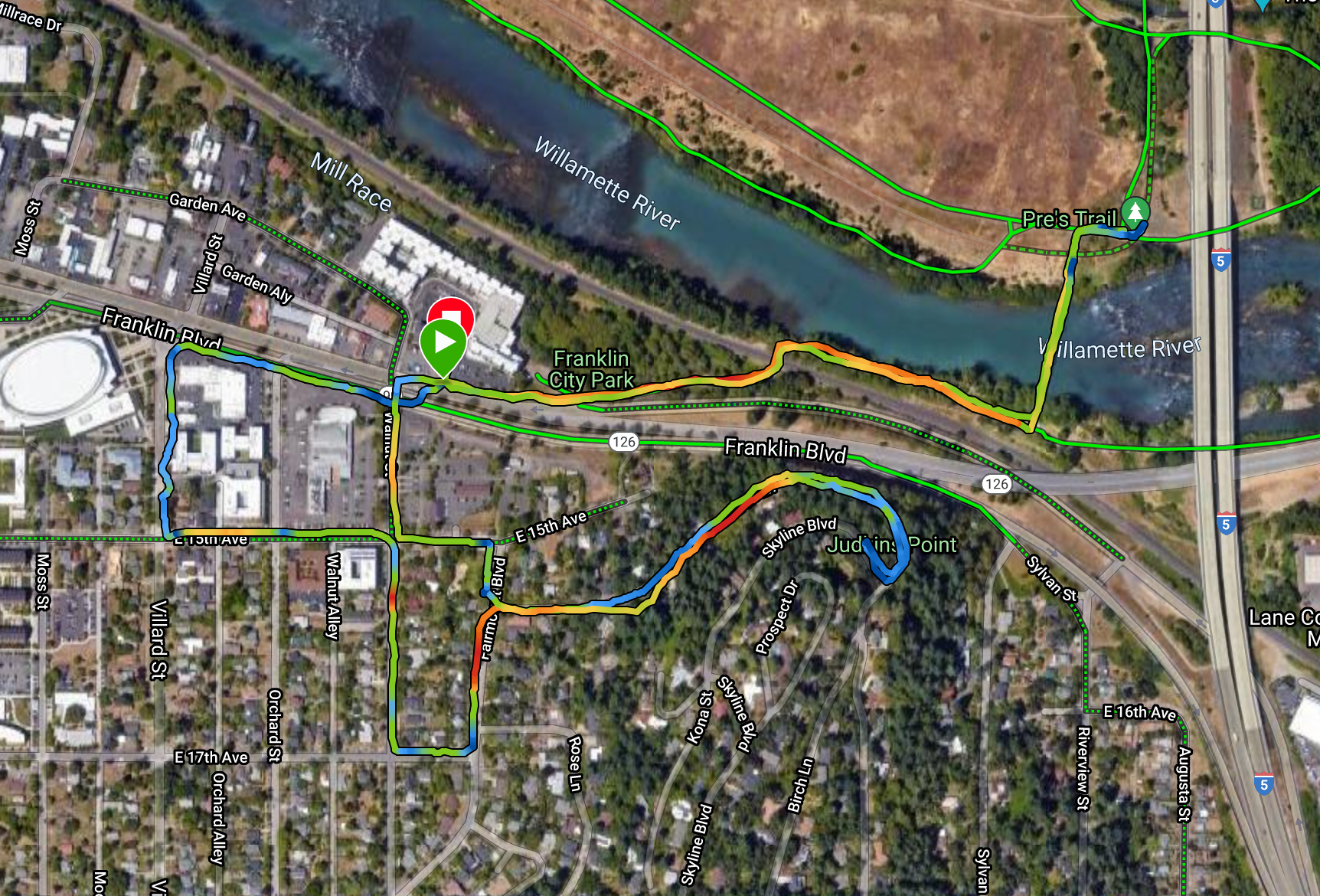
It's either left or right as I emerge from the hotel and onto the road. Having studied Google Maps, I confidently choose right and begin my run along Franklin Blvd., looking for the trail.

I'm in Eugene, and yes, I know I shouldn't be running. But I'm in Eugene. Isn't running a requirement here? I'm looking for a trail that goes through a small park, crosses the Willamette River, and then intersects Pre's Trail on the other side. It didn't look far. But I don't find the trail. Or the park.

I venture down some residential streets, and I eventually come to a sign that says, 'Pre's Rock,' with an arrow.  I don't know whether Pre's Rock is close to his trail, or even what Pre's Rock is. (Maybe something he ran up to and touched or something?) But I figure I may as well check it out since I'm having no luck with anything else.

Time for a brief interlude about Pre. Steve Prefontaine is a running phenom from the 1970s and a hero to many American runners. But here in Eugene, where he attended the University of Oregon, he's nearly a god. Pre accomplished some great feats in his short career, but then he did the one thing necessary to become a legend: he died. A car crash ended his life while he was much too young.

This winding hill would be tough even if I were a real runner. In my present condition, I'm huffing and puffing, yet barely shuffling. The hill goes on and on, but I eventually emerge near the top and then turn right onto Skyline Blvd. That's when I see it: Pre's Rock. And I immediately know what it is. Pre's Rock is not something he ran to; it's where his fatal car crash occurred. It's now a shrine, festooned with all kinds of memorabilia about Pre.

Well, that was unexpected. After my stop, I run back down the hill and back over to the hotel. When I arrive, I see right away that the paved trail that leads to Pre's trail goes the other way. I take it.

It's just a short way through the small park. In the process, I go through a tunnel. There are some homeless people in there, having an engaging conversation. I avoid them as much as possible by running through the other side of the underpass. A bit further on, I come to a pedestrian bridge that goes across the river. It's pretty cool to go across in the dark. On the other side, I encounter a whole bunch of trails leading in various directions.

One of them is the famous Pre's Trail, where he did much of his running. I run on it a little, but by now it's time to return back to the hotel. Pre's Trail is covered with pine needles, and it's very soft. It seems like a great running surface. I only wish I could run on it some more.

I'm getting back to the Holiday Inn Express, and my watch tells me that I've only run a little over 5K. It seems like it should be longer, but I decide that I'll take it. It's what Pre would do.


Pre's Rock and His Trail


Sunday, October 10, 2021

Speaking a little too soon

I may have spoken a little too soon when I bragged about running two whole miles on September 21. The next day I was yelled at by my doctor. He said I really did need the nine months recovery that he originally prescribed. To illustrate his point, he had me try to do a one-legged toe raise. I couldn't.

So it's back to swimming and walking and weights. Except for the swimming and weights. I would be doing those (as I had been - up until my trip to Ecuador) except for my shoulder injury. What happened to my shoulder, you ask? I wish I knew. I think it may have something to do with yanking luggage off the airport conveyer belt.

It really hurts, especially when I sleep, and I can't even raise my arm up. (My dad's old Vaudeville joke - Guy: 'Doc, it hurts when I raise my arm up like this.' Doc: 'Then don't do that.') But the good news is that it seems to be slowly getting a little better.

So that's where I stand. or, should I say, sit.

Tuesday, September 21, 2021

Double the Miles

Today I ran twice as far as I did on Sunday. And faster too. Now I'm cooking with gas.

What should I do next time? Depends on the type of numerical series (Arithmetic, Fibonacci, Titanic, etc.).

Sunday, September 19, 2021

My First Mile

It wasn't really all that much to write home about. Yet, here I am, writing home about it.


I ran my first mile since the May 27 surgery. Since my daily walks had gotten longer and longer, I thought I'd give it a whirl during today's sojourn. How did it go, you ask?


Pretty bad. But it could have been worse; it could have not happened at all. But as it was, I ran said mile in fourteen and a half minutes. Believe it or not, there have been times when I've actually run even slower. That's another way it could have been worse.


Where to next, you ask? Heck if I know. Okay, I'm pretty sure that I won't be doing any ultras for a while. Or even very much running at all. It's still baby steps for me. But maybe a few more of them in shuffle mode.

Monday, August 30, 2021

This boot was not made for walking


This boot was most definitely not made for walking. But I have been walking, even though I'm still in it, at least for the past two weeks or so. The thing is, I've been wearing it a little less each day, and this has enabled me to do my PT, but also to walk more and more in the hours that I'm not in it. I'm now up to three or more miles each and every day.

But as of now, I am done. Done with the boot entirely. I'll have to send it up to boot heaven.

I'm feeling slightly better as well. The muscles and tendons are still not entirely working together yet. I wouldn't be able to run if my life depended on it. That's why I'm continuing the PT. I also intend to get back (for the first time since the pandemic hit) to swimming and doing other pool exercises.

And, of course, the walking.


Saturday, August 14, 2021

Get off my lawn!!


(Veronica and Barry thought it might come to this when they heard I would be getting hearing aids. They will go nicely with my cane when I yell at the neighborhood kids.)

But since this is a running blog, here's a quick update on my recovery. And it is somewhat related. I've graduated to a cane now; there will be only a little more use of the knee scooter and crutches. This is because I can now place my full weight on my right foot. It's still tough to walk a whole lot due to the height difference of the booted vs the non-booted foot. The cane helps.

In the next two and a half weeks, I will be removing lifts from the boot, and then ditching the thing completely (yay!). I'm also doing PT. That's all good news. And it can't come too soon.

Wednesday, July 28, 2021

Two Months Later

It's been two months since my surgery. My recovery is on schedule, but that means I'll be in this dang boot for at least another month and a half. As of this week, I am beginning physical therapy and I can start to put a little weight on it. I go back to the doctor in another two weeks, so there may be an update after that. The best news is that although there's still some swelling and numbness, I'm not in any pain.

Thursday, July 15, 2021

Dan's Complete Running History in ten-year increments.

Memories. They're all I got right now.

There will be no current running content in this post. I will say that it was kind of cool to meet up with some of my MCRR friends for a group run at Brunswick Lake yesterday. Of course, I scooted while the rest of them ran.


It occurred to me, however, that twenty years ago, I successfully completed a 100-mile run, the 2001 Mohican 100. Then I began to think about my second attempt, ten years later in 2011. And then I started to wonder what I was doing ten years before that, and so on. Here then, is a chronology of Dan's Running History in ten-year increments.


1971 (Fifty Years Ago)

Not much to report here, running-wise. I graduated from Holy Name High School and began college at The University of Toledo (I later transferred to Cleveland State University). I only ran one year of track in high school, and that was during my first year. I will say that I did, very occasionally, go out for a run. This was pretty unusual in those days, however. People didn't just go out for a run. But then, I was somewhat on the strange side. I should note that I consider the start of the running boom to be the following year, 1972, when Frank Shorter won the Olympic Gold Medal in the Marathon. I didn't really become serious about running until a couple years after that.


1981 (Forty Years Ago)

I ran the Athens Ohio Marathon in 1981. My first marathon had been in 1978, and this was my second. I crashed badly and struggled in for a time of 3:21. Although the 3:04 I did three years earlier was faster, I was now two for two in wall-crashes at marathons. It probably would have been a good time to quit. But I didn't. I ran Athens again two years later (with similar results) and started running more of them in the late 1980s.


1991  (Thirty Years Ago)

Four marathons in 1991. That tied 1989 for the most marathons in a year. And they were all pretty decent. 

Note that there were no sub-3 hour ones, however. I did break 3 in 1989, earning myself the right to run Boston in 1990. I suppose you could say that 1991 was a down year because I did break 3 again in 1992. 1992 was also the year of my first ultra: the Olander Park 24-Hour Run.


2001 (Twenty Years Ago)

As was typical by now, I ran four marathons in 2001:


The big news about 1991, however, was my completion of the Mohican 100. I'd never even come close to running so far, and I really didn't know what I was doing. But somehow I made it, and it was one of the most memorable runs, not to mention greatest accomplishments, of my running life. 


2011 (Ten Years Ago)

2011 saw another attempt at Mohican. It was ten years after my first, and I shouldn't have tried. It was a complete disaster.

Ironically, 2011 was a stellar year, otherwise. 

The marathons were okay:


But the ultras were really good (for me):


Those included PRs at 50K and 100K. But no matter what, that Mohican 100 failure managed to define me. And not in a good way.


2021 (Today)

Well, you know the story here. 

I will say that I do plan to be making more running memories. Just not for a little while.

Sunday, July 11, 2021

Booty McBootface

"Boaty McBoatface" is the name of a British lead boat in a fleet of three robotic Autosub Long Range (ALR) class of lithium battery-powered autonomous underwater vehicles. The name was jokingly suggested but quickly became the most popular choice for an online naming poll.

"Booty McBootface" is a name I've given myself to commemorate my confinement in this confounded boot. It's been weeks and weeks now, but I don't think I'll ever get used to the darn thing. I only remove it for sleeping and showering. It's getting mighty old. I know, I know. So am I.

Not only can I not walk in it, I can't even put weight on it. That may possibly change next Friday, when they will evaluate my progress and possibly allow some weight-bearing. I may also begin physical therapy at that point. 

In the meantime, the only exercise I get is my morning push-ups and crunches. That's been IT! But just today I began to do some work with dumbbells. I'll do more of that.

But for now, suffice it to say that I'm pretty much going Booty McBootface Bananas.

Friday, June 25, 2021

Finding my boot and crutches

entered the third door of St. Wenceslas. It’s the one the younger elementary school kids use. I’d left my boot (I’m done with the cast now) and my crutches inside. I went up the stairs and entered the office-building-like interior. It was connected with other office buildings, and as I ran, it started morphing into a shopping mall. I know. I shouldn’t have been running because it was probably bad after the surgery, but I needed to get that boot and crutches. But then, all my dreams involve running these days.


I found the boot, right where I’d left it, in a corner of the mall. After I got it on, I bumped into Joe Biden, who asked me all about my surgery and recovery. Even though his questions were made with genuine concern, I was slightly irritated because I’d recently had the same conversation with him. Sheesh, I thought. Doesn’t he remember? Anyway, I was nice and respectful in my replies.


I finally found all the crutches. There were a bunch of them hanging in a center-mall kiosk. I considered taking some others when I couldn’t find mine right away. But that would have been stealing. I finally found my own, and everything was okay.

Thursday, June 03, 2021

Short-Term Pain, Long-Term Gain

Remember the famous experiment where they tell the two-year-olds that they can have one marshmallow right away, or two if they wait five minutes? The ones that were willing to wait - to consider delayed gratification - evidently are willing to put up with some short-term pain (having to wait) for the long-term gain (getting two, rather than one marshmallow). Interestingly, the same kids that were willing to accept the delayed gratification were also more willing to do so for other aspects in later life and were therefore generally more successful. At the very least, they got more marshmallows.


The stitches on the back of my heel (the rest of my foot is there, just obscured)


Had I been a subject of this experiment, I would have been with the two-marshmallow group. In terms of my running, and use of my Achilles Tendon in general, my choice has been to accept the pain now with hopes of being pain-free later. The short-term pain - the operation and subsequent recovery, has been tough. Although the operation went well, I found myself in a whole lot of hurt once the "block" wore off.


Me and my scooter. The grandkids love it!


That pain did subside after a couple days, and I'm feeling better now. But the other "pain" thing is just getting around with the bandage-wrap and now the cast. And that has also been a real pain in the patoot. What's more, it looks like I will be non-weight-bearing for quite a while still. Thank goodness for the knee-scooter that Dave Koch lent me. It's so much better than the crutches. Even so, it's still tough (at least more than I thought) to do normal, everyday activities.

I believe the plan is to have me remain in a cast for three more weeks, at which point I will transfer to a boot. After that, I'll begin Physical Therapy and a slow transition to weight-bearing.


My new black cast. Ain't it cool?


That transition to the long-term gain can't come soon enough.

Friday, May 28, 2021

Post-Op


So far, so good. I am told that the surgery went well, and now comes the recovery. It's not easy getting around and being careful, but maybe I'll get used to it.


Wednesday, May 26, 2021

Last Run... (for a while)

I was thinking that yesterday's run would be my last before tomorrow's surgery. I met up with an old friend, Dave Gajewski, and we had a chance to catch up on a lot of things. Surprisingly, when I awoke this morning, I felt like I was ready to run again. Now, this would be my last run before submitting to the knife.

Besides the usual joy of running and getting outside to enjoy nature and getting myself into some kind of shape (better to say keeping myself from getting into worse shape), I had another incentive to get out today. The Moon was full, and it was a blood-orange supermoon, and it was about to be eclipsed by the Earth's shadow. I was aware that it may be obscured by clouds, and even if not, most of the eclipse wouldn't occur until after the Moon had set in these parts.

But it was worth a shot. I could indeed see the Moon, low in the Southwest, as I began my run at 5:00 AM. For the best viewing of the setting moon, I ran to the highest place with the best visibility I could think of: St. Ambrose Church and School. It's adjacent to Brunswick's two water towers, a clue as to its relative elevation. Clouds came and went at times, obscuring the view. But every time I thought it may be gone for good, it would reappear. Each time I saw it, it was more orange. And of course closer to the horizon.

It was pretty cool to watch it set. I couldn't really tell whether the eclipse was visible or not because of the dancing clouds. But it was cool, nonetheless.

After the show, it was back to running. I could just run the two miles back home, but instead, I explored some of the city streets to the East of the church. I'd been on some of those roads before, but not often and definitely not recently.

Eventually, I wound up on Hadcock, and then headed back to the West via Keller-Hanna. By the time I got home, it was time to get ready for my MRI. I was happy to get these slow and easy six and a half in. I hope I'll be able to run again, and the sooner the better.


I can't accept credit for this photo; I found it on the internet. But it IS the way the Moon looked today.


Friday, May 21, 2021

AT Surgery

A little over seven years ago, I began to experience pain in the back of my heel. Of course running seemed to be the cause, but walking and even driving also appear to be culprits. Since then, the pain has subsided at times, but a lot of driving, as well as intense or long runs often bring it back in full swing. It’s always there at some level.


It was diagnosed as Achilles Tendinitis. Over these years, I tried all kinds of non-invasive medical treatments, acupuncture, physical therapy, taping, and a variety of drugs and ointments (ibuprofen works best). Nothing seems to work completely. Even when I don’t run, I still experience pain from walking or driving. Of course, when I do run, the pain is that much worse, mostly afterward.


Being sick and tired of hobbling so much, I’ve decided to get surgery to try to fix the problem. It’s next week. I’m told to expect a recovery of about nine months. I hope that after that, I will be able to run again. Maybe even pain-free.


To my running friends, it’ll be like I am in quarantine again. I’ll miss you all.

Saturday, May 08, 2021

Fragrant

Fragrant. That's the word to describe today's run. No, not me. I'm talking about the wildflowers along Lester Rail Trail, lending their scents to any runners who happen by.

~

As it happens, there are some runners on LRT today. They appear to be Harold Dravenstott, Andy Wolff, Michelle Wolff, and Dan Horvath. The sun comes and goes, as clouds move in and out. There's some misty rain, and then other bright times. Harold has to leave, and then later on the Wolffs do as well. Dan is all alone.

This is almost like old times, thinks Dan. He used to do extra miles - more than anyone else, and he's doing so now, he thinks. But then reality occurs. His Achilles tendon makes itself known with the beginnings of what Dan knows will lead to the usual big-time pain. And the other reality is that this run will only be, at most, twelve miles, as opposed to one of Dan's long runs of 18-20. He hasn't done anything like that in months and months. But he's reasonably happy with today's twelve. Even that is the most in several months. 

As he's finishing up. the pain is coming on strong. And it does indeed assert itself even more on the ride home.

Dan tries to think about the fragrant flowers instead.

Monday, May 03, 2021

Over it (the personal reasons)

In an earlier post, I expressed the practical reasons why I wouldn't take back the NorthCoast 24-Hour Endurance Run (NC24) Race Director duties. I finished that post off by saying that "my life has changed, and I've moved on." I thought I'd talk a little bit more about that moving-on statement.

Northeast Ohio is home to a wonderful and accomplished ultrarunning community. Ultrarunners are great people, and they make loyal and lifelong friends. I mentioned Larry Orwin in that previous post. He's one of them. For a good decade or so, I was proud to consider myself a member of this group. 

Unfortunately, a couple years ago, I gradually found that I was no longer able to participate in many of the ultrarunning events due to physical problems and limitations. I won't go into all these, but suffice it to say that they're related to age and injuries. As a result, I've participated in fewer and fewer ultra runs, and I've slowly become out of touch with many (but not all) of my ultrarunning friends. I suppose this is just part of moving on and getting over things.

I am not even going into the toll RDing takes on loved ones. Or the considerations for travel and any other personal events.

It's hard to have a fire in the belly when you're in pain. And it's hard to remain in touch with some of the people who still have that fire. It's enough to get you over it. And to move on.

Over it (the practical reasons)

The NorthCoast 24-Hour Endurance Run (NC24) began in 2009. I was Race Director that year, and I continued to assume the RD duties each year through 2015. Being RD was a ton of work and worry, yet it was enormously fulfilling. This was mostly because we had a dedicated team of individuals, all committed to working together to make and keep NC24 the world-class event that it was. I absolutely loved these friends; they were like family. Here is a post about these wonderful people. 

It was with great gratification that I was able to witness the continuation of the race by Vertical Runner Race Management (now Mid Ohio Race Management). Something I started (and put my heart and soul into) had persevered; I couldn't have been happier. But NC24 did not take place in 2020 due to Covid-19. And now the question arises, what will happen in 2021? Mid Ohio Race Management has not said anything, and many wonder whether the event will take place at all again this year.

My friend Larry Orwin has been one of NC24's greatest promoters. He was part of that great race organization team and has also run the event (often quite well) many times. Because of the uncertainty about Mid Ohio Race Management (and probably without communicating with them), Larry asked me if I would consider taking back the NC24 RD duties. The question gave me pause.

As you may have noticed from what's been said so far, NC24 was a wonderful experience for me. What would happen if I tried to resurrect the race and my position as RD? Here's a shortlist of some of the many things that would need to happen.

1) The reincarnation of the event would need to be financially viable. This means getting substantial sponsorship funding because the race fees are not enough to absorb the costs.

2) The race organization team would need to be rebuilt. NC24 was a Medina County Road Runners (MCRR) club event until 2015. Mid Ohio Race Management made it a for-profit event thereafter. As RD, I was able to get MCRR members to volunteer. Organizers and volunteers would need to come from someplace for any future event.

3) The location would need to be secured. Although there have been challenges, Edgewater is an awesome place to hold a run such as this. NC24 wouldn't be the same anyplace else. Yet obtaining the permit (which was never easy) may no longer even be possible for a lot of reasons.

After thinking about it in these terms, not to mention all the additional considerations, I now realize that I can no longer realistically expect to direct NC24. It's sad but true. My life has changed, and I've moved on. My 'NC24 RD' era is over, and as much as I hate to say it, I'm over it.


Friday, April 30, 2021

California Runnin'

 California Running


We visited California in order to see all of its wonderful National Parks. I was able to get out and do a little running as well. Here are the stories of those runs.


Twentynine Palms


They say it gets cold in the desert at night, and they’re correct. But it’s a dry cold.


We stayed in Twentynine Palms in order to visit nearby Joshua Tree National Park. This is the desert, folks. Big-time. And the desert can be a fine place to run early on an April morning. It was pleasantly cool, and the stars were shining brightly. I didn’t get real far, but I loved it!


Carpinteria


In my neck of the woods, it’s fairly unusual to spot seals during a run. I guess it’s less uncommon here in Carpinteria. This seaside beach town near Ventura was our home base for our boat ride to Channel Islands National Park (where I managed to also run a tiny bit up a mountain after our hike). It’s a neat place to run with beaches and bluffs galore. There is a lot to explore, and explore I did. 


In Carpinteria after the run along the shore


Of course, I didn’t manage to run as far or as fast as I’d planned. But when did that ever happen?


Marina


I’m running uphill in order to get down to the beach. That’s what happens when you have HUGE sand dunes. After a certain point, I am running through soft, sinking sand, and my progress, slow as it was, becomes much slower. I do make it to the beach (and this involves a steep descent from the dunes), and it’s pretty cool so early in the morning.


Incidentally, Marina is near Monterey, also on the bay of the same name. We’re here to visit Pinnacles National Park, which is an hour away.


American Canyon


This is the gateway to wine country, and we’re here to visit Napa Wine National Park. Okay, it’s not quite an NP, but we’re treating it like one – visiting as many wineries as humanly possible in a short period of time.


The running is surprisingly fantastic. It’s surprising because after reviewing the area on Google Maps before heading out (as I always do in unfamiliar territory), I still hadn’t been aware of the nearby Bay wetlands trail system. But the area and trails are extensive.


The thing is, like most guys, I don’t like to turn back. Instead, I prefer to find circular routes, but this is hard when you don’t know when or whether the course will take you back at all. No one said this attitude of mine makes any sense. As I head out on the trail, there’s a closed-down landfill on one side (complete with facilities to convert the methane to electricity and also goats to eat the grass), and wetlands on the other side. I keep thinking that the trail will curve around to the left, circumnavigating the wetland lakes. It doesn’t. It goes on and on, eventually curving back to the right. Now I am hoping that it will return me to my starting point after going around the landfill. It does.


That wound up being around three of today’s seven miles. Along the way, I saw and heard wild turkeys, coyotes, wild chickens, said goats, and all kinds of birds. Not to mention one hot-air balloon. 


Klamath


Owl: Who, who is that, running on the road?

Raven One: It’s just a human, out for his early-morning run. He’s got a headlamp. And one more thing.

Owl: What’s that?

Raven One: Nevermore.

Big-as-half-a-fist Slug: I see him. Look out! He almost stepped on me! Watch it, buddy! I can probably out-run you, anyway.

Nearby Snail: Me too!

Raven Two: Hey Human, I hope you are enjoying this. We’ve got perfect peace and quiet. The Klamath River that you’re running above (at times, way above), is beautiful and serene. Now that it’s getting lighter, you can see across and to the cloud-hugging hills beyond. Notice the tall redwoods all around you. Stop and enjoy it before you move on.

Human: Okay, you’re right. It’s great.

Woodpecker: Peck, Peck, Peck.

Raven Two: Oh, and one more thing:

Human: What?

Raven Two: Nevermore.


Redding


Goals for today: 1) Get some real running in, not the junk that I’ve been doing; 2) Get some mileage in, not the junk that I’ve been doing; 3) Explore and have fun; just like I’ve been doing. We’re in Redding because we visited Lassen Volcanic NP. 


Plan A: Parsons High School (Home of the Tigers!) Track – I discover that the track, and even the school grounds, are locked up tighter than a drum. I do manage to get into the school area, but then I think better of my chances of getting arrested for trespassing, so I leave.

Plan B: Run along the Sacramento River – There are people in the woods. I am on the dark trail, and I encounter some clothing hanging on a makeshift clothesline in the woods. I then realize that this is a homeless-type camping situation, and here I am running through with my headlamp. I then see other people, like zombies in the woods. Maybe they ARE zombies? I’m out of here too.

Plan C: Run along the Sacramento River (on the GOOD side) – There is a paved bikepath on the opposite side of the river, and I eventually find a way across and onto the path. It’s good running, but I’m nearly out of time, so after crossing the famous Sundial Bridge, I turn and head back.


As for my goals, here are the grades – 1: C, 2: B, 3: A.


Merced


This “Gateway to Yosemite” isn’t so much of a gateway because it’s over ninety minutes away. But the running would be good, wouldn’t it? 


Let me state upfront here that I’m not a pervert. Yes, yes, I run through school grounds in the early-morning darkness, trying to break into tracks (unsuccessful for the second straight run). And yes, I occasionally pick things up that I find – things that would be better off left where they lie. Like that dildo in Indiana. This time it was a couple of cards with pics of young ladies. One is a California ID card and the other is a  California driver's license. Now that I have these in my possession, I suppose I’ll have to take them back and mail them to their owners.


This run is mostly on the wrong side of the tracks, literally and figuratively (it’s a poor part of town). Due to the tracks and frequent trains, I almost can’t get back without retracing my steps. I don’t want to do this, but I do, and it gets me the ten miles that I wanted. A slow ten, but a ten nonetheless.


Ridgecrest


I'm in the trashy (figuratively and literally) part of town. Some neighborhoods were fairly nice. But this area, back closer to the hotel, is awful; there's litter everywhere. This is not to say that the running itself has been good.  But more on that later.

By the way, Ridgecrest is home to the China Lake Naval Air Weapons testing station. Also by the way: there is no lake here (it's a desert) and it's not in China. Furthermore, there is no ridge, nor is there a crest here in Ridgecrest. We're here in order to visit Death Valley National Park.

As nice as it is to run in new places and discover things, I wish I could run well. But the Achilles pain is too severe. I just shuffle around for six miles instead of the planned ten.

Story of my life.

Here's the link to the travel blog post.

Sunday, April 11, 2021

Boston 2.1 Half-Marathon Race Report

It feels the same, says Dan, to no one in particular. That's because no one is running nearby - the Boston 2.1 course is pretty spread out, you see. Besides the smattering of other runners, there are a few bikers and the occasional Amish buggy. What feels the same is the running. He ran the 2.0 version of this race about six months ago, and there were several similarities, with only two notable differences.

Similarities: Same great out and back course on the all-purpose trail through Amish country. Same wonderful weather. The friendly small-race atmosphere is just as fun. The pace, like last time, is fairly steady the entire way, and Dan will try to finish strong. Or at least not weak.

Differences: Dan ran twice as far last time. And Dan ran about a minute per mile faster last time. No big deal(s).

Dan wonders how things could have gone so far south so quickly. The Achilles pain did not help.

At least he got through this without too much embarrassment. At least the pace was steady. At least he's still walking erect afterward. Barely.

Final time: 2:06. It could have been worse.


Friday, April 09, 2021

Not a Run Report

As I hobble around the house like usual today, I have an extra little spring in my step. That's because, for the first time in the past 372 consecutive days, I took a day off from running.

Why would I do such a thing? The best reason I can provide is, I just didn't feel like it. And how do I feel about this now? Pretty damn good.

Tuesday, April 06, 2021

Meteoric

They always appear when you least expect them. It's a minute or two after five, and I am driving towards the track where I am to meet Michelle Wolff for some speedwork. The entire sky suddenly brightens and then goes dark again. I look up and see the cause: a very bright green moving object. It's much brighter and faster than a plane, As soon as my brain can determine that it's a meteor, it disappears back into the darkness.

Michelle tells me that she didn't see it. She had probably not started out yet. The important question in my mind now is: would today's run be as meteoric? I'm mostly kidding here. I haven't done anything at all speedy for a good month. But today, I'm going to try. A little.

The important thing is to not hurt myself any further. I usually do pay for anything ambitious with excruciating Achilles pain. If I'm going to hurt anyway, why not push it a tiny bit faster?

Michelle has her own program. I decide to do some gentle 800s. I do one in about 4:10. That's slow, but I am happy with it. The best part is that it actually felt good. Not the Achilles, although that could be worse. No, I mean that it just felt good for my whole body to open things up. NO MORE SHUFFLING!!

I manage four more like that, and I realize that that's enough. Not quite meteoric, but I'm quite satisfied. It's good to feel tired and sore without having pain that's completely debilitating.

During breakfast, I remember to ice my Achilles. It still isn't too awful. But five minutes later, it is. It's completely awful. Debilitating with a capital D.

I don't know whether it was the ice or just a delayed reaction to the relatively hard run. But it's disappointing. And painful.

Saturday, April 03, 2021

Run 1 of Year 2

After one year of running every day, you would think I would have learnt a thing or two. Especially when things went downhill so much towards the end of that year. But no, here I am, running again, without a day off.

Even though it's cold, it doesn't feel as frigid as yesterday. Today, I'm running on the Lester Rail Trail with Andy and Michelle Wolff, and Harold Dravenstott. Our blistering-fast early pace has slowed just a little. After some back and forth (the entire trail is only three miles long), we drop Harold off and go on for more. About 12 down, 4 to go, think I. Perhaps I will be able to do it if we run slow enough. I thought I'd heard Michelle say that she and Andy were going for 16. It turns out that she said 14. That's a huge difference. HUGE.

We complete the final few, and I feel pretty good. Pretty good like I just ran a good strong long run good, not pretty good like I only ran a few steps good. I may need to begin calling 14 miles the new 18 miles, so it can be considered a long run.


Friday, April 02, 2021

Streak!

I did not run on April 2, 2020. But I have run at least a mile – usually much more - every day since. I know other runners with multi-year streaks, but this one-year thing has been a big deal for me. Not that I would recommend such a thing. In fact, I’d rank it up there with some of the dumbest things I’ve done, running or otherwise. Here are some further thoughts.

The reason such a streak is new to me is that I’ve always thought that taking one or two days off per week is a good thing to do. Now, I think so even more.

This year-long streak coincides nicely with the worst 12 months of the pandemic. That’s no accident. For one thing, although I like to run when I travel, I sometimes miss a day here and there, especially when I have a long flight across time zones or some other major time constraint. But since the only recent travel has been via road trips, I haven’t had this as an excuse. I should also add that owning a treadmill has helped, mostly because the winter was so bad, and we couldn’t get away to someplace warmer. 

3,719 miles. That’s slightly more than the number of miles covered from January through December of 2020. It averages out to 10.18 per day, and it does not include walking miles. This is not to say that the running was fast, however. It was the slowest of my life. My average pace for these miles was just over 11 minutes per mile.

Even though the pace has been slow, some of the miles were actually okay. They include the GVRAT miles (May through August), and a pretty good marathon last October. Because of this, had someone asked back then how the streak was going, I would have provided a positive response. 

Recent weeks, however, have not been good at all. My Achilles Tendinitis pain suddenly became much worse after a track session about a month ago, and the running has been awful since. And even though my mileage was steady (at about 70 per week) prior to that, much of the running was just shuffling or being a treadmill wimp.

Bottom line: I need a day off. Maybe even more than one. It will come sooner rather than later. At that point, I’ll be a little less dumb.

My weekly mileage (notice the downward trend)