Monday, September 05, 2016

TM Speech: The Glass is Half Full - The Power of Positive Thinking (You Guessed it: No Running Content)

Dearest Readers,


I have recently given some speeches in connection with my Toastmasters International membership. Some are related to running, and some are not. When possible, I will publish the speeches. This is one of them.


The Glass is Half Full - The Power of Positive Thinking

Always Look on the Bright Side of Life
Singing: “Always Look on the Bright Side of Life….” That is from a Monty Python Movie called, The Life of Brian. Jesus and several other men are being crucified, and one guy, who is dying on the cross, begins singing that happy song. Soon the others join in, and everyone is smiling and thoroughly happy. It’s a preposterous scene, even for Monty Python.

But ludicrous though it is, it demonstrates an important aspect of human nature: the power of positive thinking. Those guys are going to die, but they seemingly couldn’t be happier. 

In the words of author/minister Norman Vincent Peale, “The way to happiness is to keep your heart free from hate, your mind from worry. Live simply, expect little, give much. Scatter sunshine, forget self, think of others.” Positive thought makes positive people, and positive people accomplish great things. Not the least of which is personal happiness and fulfillment.

Optimism comes from the Latin word optimus, meaning "best," which describes how an optimistic person is always looking for the best in any situation and expecting good things to happen. Optimism is the tendency to believe, expect or hope that things will turn out well. Even if something bad happens, an optimist sees the silver lining.

The emerging field of positive psychology studies the positive impact that optimism has on mental health. Other research shows that optimism may be good for physical health too—optimists are sick less and live longer than pessimists. Apparently, a positive outlook on life strengthens the immune system (and the body's defenses against illness), cardiovascular system, and the body's ability to handle stress.

 
Fake it Until You Make it
Can You Boost Your Bright Side?

Although a positive personality is something we’re often born with, there are steps you can take to improve your outlook and reduce your risk of cardiovascular disease.

Simply smile more.

A University of Kansas study found that smiling—even fake smiling—reduces heart rate and blood pressure during stressful situations. So try a few minutes of YouTube humor therapy when you’re stomping your feet waiting in line or fuming over a work or family situation. It’s difficult not to smile while watching a favorite funny video.  

Practice reframing.

Instead of stressing about a traffic jam, for instance, appreciate the fact that you can afford a car and get to spend a few extra minutes listening to music or the news, accepting that there is absolutely nothing you can do about the traffic.

Build resiliency.

Resiliency is the ability to adapt to stressful and/or negative situations and losses. Experts recommend these key ways to build yours:
• Maintain good relationships with family and friends.
• Accept that change is a part of life.
• Take action on problems rather than just hoping they disappear or waiting for them to resolve themselves

It’s Contagious

Both pessimism and optimism are contagious. If you associate yourself with optimistic, happy people, you’re disposition will reflect those qualities. So of course you should, when possible, spend time with positive people.

Smiling is contagious. Laughing is contagious. I mentioned the health benefits of smiling; they’re even greater for laughing.  If I start laughing, most of the rest of you will as well.

TM Speech: The Art and the Joy of Movies (As the Name Implies, No Running Content)

Dearest Readers,


I have recently given some speeches in connection with my Toastmasters International membership. Some are related to running, and some are not. When possible, I will publish the speeches. This is one of them.


The Art and the Joy of Movies


Our Art Form

For some cultures, like 19th century Germany and Austria classical music was the predominant art form.
The ancient Greeks invented theater.
Sculpture was extremely important to the Greeks and also ancient Italy.
England and Ireland, and China can lay claim great literature.
Painting is most famously attributed to France and other parts of Western Europe
For other cultures, architecture, modern music and dance have.
What is our culture’s art form?
Western Civilization’s and specifically the United States’ art certainly include all the forms I’ve mentioned. But what will we be known for, in perpetuity? I think the answer is film.


What is a movie, and how or why can it be considered art?

A great movie can transport you to another time or place. It may be a time or place you could never get to yourself, Or it may be something as mundane as everyday life. 
It can inspire or depress you. It can make you laugh or cry. It can do all or none of these things.
Movies enable us to forget about of the day-to-day drudgery of our lives for a period of time.
You can get lost in a great movie.

Most films begin as a business idea; it’s often all about profit.
Producers pull together writers, directors and actors, and they also arrange for funding.
Directors take the work of the writers, and work with the actors to create the magic we call a movie. At its best, this is the art of film.


Dan’s Ten Best

Do you have an all-time top ten movies list? When you love great movies as much as I do, it’s fun to think about your favorites.
A couple caveats:
Genre doesn’t matter much to me – I like movies of all sorts. The main question is this: is it a good story?
Does the picture do what was intended? Some have modest goals, but exceed them. Some have difficult goals, and fall short. A few are both ambitious AND also succeed in accomplishing what they set out to do.

Here’s my list, in no particular order:


  • Gone with the Wind

    • The Wizard of Oz


    • 2001: A Space Odyssey

    • Casablanca

    • American Graffiti

    • Giant

    • Ben-Hur

    • The Godfather

    • The Right Stuff

    • Animal House

    • Dr. Strangelove


    Yeah. I know it. There's actually one more than ten there. But it's my list, and I can do what I want.


    Don't Like My List?


    TM Speech: A Run Through History (Yup - check it out if Running Content is what you seek)

    Dearest Readers,


    I have recently given some speeches in connection with my Toastmasters International membership. Some are related to running, and some are not. When possible, I will publish the speeches. This is one of them.


    A Run Through History


    • Held every four years at the sanctuary of Zeus
    • War and other hostilities were halted during the Games
    • They were for men only. And naked ones at that. Women eventually began their own games
    • Wrestling and running were the main events. To our knowledge, the main distance was 1 Stadia/Stadion – about 200 yards
    • The ancient Olympics were permanently halted in 393 AD, when the emperor Theodosius I decreed that all pagan cults and practices be eliminated


    • We all know about Pheidippides running from Marathon to Athens in 490 BC, don’t we?
    • BUT - did you know...
    • The distance was about 25 miles
    • He ran 150 miles (Athens to Sparta) during the prior days
    • The first marathon run for competition was in the modern Olympics (inspired by a poem)
    • The marathon distance was changed to 26.2 miles in the modern Olympics in order to run by the Queen of England
    • In 2010 we celebrated the 2500 year anniversary – how’s that for a tradition
    • The entire Pheidippides is probably only a myth. But it sure is fun


    • Baron Pierre de Coubertin founded the International Olympic Committee (IOC) in 1894
    • Panathenaic Stadium was restored for the new games held in Athens
    • Games began in 1896
    • Events included different running distances, including a new one called the marathon, to commemorate the legend of Pheidippides
    • First “Competitive” Marathon won by a Greek named Spyridon Louis
    • Held Every Four Years, just like the ancient ones
    • Interrupted by World Wars I and II
    • Women’s track events were added in 1928
    • Until 1984, Women were not allowed to run distances farther than 1500 meters


    • Or third, if you count the one by Pheidippides
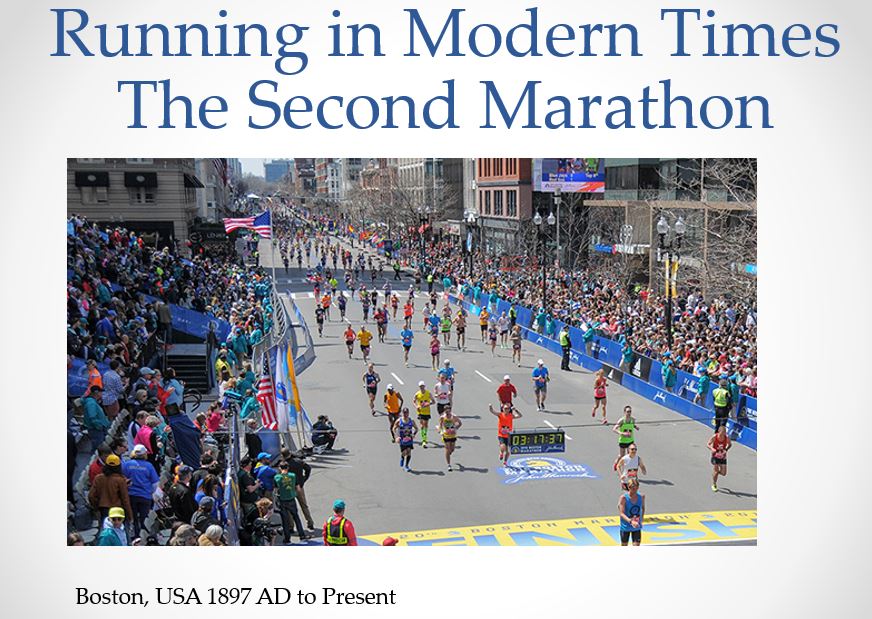
    • Guess what? It’s Boston – 1897
    • Founded by Boston Athletic Association, inspired by first Olympic Marathon
    • Boston’s Long History nearly matches that of the Olympic one
    • More…
    • At the 1908 London Olympic Games, King Edward VII and Queen Alexandria wanted the marathon race to begin at Windsor Castle outside the city, in order for the Royal family to view the start
    • This made the distance 26 miles
    • Runners ran an extra 385 yards around the track as they finished in the stadium
    • Boston and other marathons adjusted their distances


    • Katherine Switzer entered the 1967 Boston Marathon as K. Switzer. RD Jock Semple tried to manually remove her, but her boyfriend intervened. 
    • These photos appeared in Boston Globe
    • Bobbi Gibb had run it in 1966
    • Women were officially allowed to enter Boston in 1972


    • From Cleveland / Ohio State
    • American track and field athlete and Olympic gold medalist
    • At the 1936 Summer Olympics in Berlin, Germany, Owens won international fame with four gold medals
    • As the most successful athlete at the games and as such has been credited with single-handedly crushing Hitler's myth of Aryan supremacy


    • Became the first to run under 4 minutes in the mile – 60 years ago in 1954
    • Since then as many as 1,000 runners have broken the barrier, a select few whilst still in high school
    • Very few of them have been able to do it on a cinder track as Bannister did
    • Sebastian Coe was the logical successor to Bannister


    • F: Won Olympic Marathon in 1972
    • J: Won 1st Women’s Olympic Marathon
    • Boston, Chicago Winner
    • Former WR holder


    TM Speech: 180 Steps (Actual Running Content Included at NO CHARGE!)

    Dearest Readers,


    I have recently given some speeches in connection with my Toastmasters International membership. Some are related to running, and some are not. When possible, I will publish the speeches. This is one of them.


    180 Steps

    Like many others here at Progressive, I am a data person. Let me share some data with you. I have been running more or less regularly for over forty years. I’ve documented more than 93,000 miles. That’s getting close to 100,000, and it’s also close to four times the circumference of the earth. Not to mention 40% of the distance to the moon. I have written multiple articles about running for a national magazine, published a book, written a blog, served as a running club president and worked part-time at a running specialty store. Included in all those miles are over 100 marathons and over 30 ultramarathons.  Is that enough to establish some credibility for this subject? And yet even with all those miles, I still try to improve my running form.

    I know that some of you are thinking, “I’m not a runner. What do I care about running form?” But you are a runner. Maybe you don’t run every day. Maybe it’s been a long time since you have run. But you almost certainly did run when you were a kid. And you can and should run now. Running is natural for us human beings – as much as walking. In fact, running is more efficient. This is a good subject for another speech. You can expect to hear more about this particular topic in the near future.

    Others of you are thinking, “I am a runner, but what do I need to know about running form? Isn’t it just putting one foot in front of the other?” Now we’re getting somewhere. Paying just a little attention to your running form can have a very positive effect. It can make you a more efficient and effective runner. Besides improved performance, you help reduce the possibility of sustaining an injury.

    I mentioned that you ran when you were a kid. Almost everyone runs when they’re a kid. Next time you see kids running, pay attention to their running form. In fact, you may be able to picture it in your imagination right now. That form is nearly perfect, isn’t it? Kids – at least while they’re running - tend to have great posture, a light, efficient footstrike and fast cadence. These are the elements of good running form that I would like for you to take away from my speech today.

    Everyone stand up. Your posture should be tall. You should reach for the sky with your head. Now lean forward just a little so that your heels are off the ground. Now pump your arms forward and back. Feels like you want to run, right? Your arms should be at a 90-degree angle, with your forearms facing out. But having said all that, you should be relaxed. Especially your hands and your face. You can practice these posture suggestions even without running.

    Heel to toe is the best way to land, right? Wrong. Your foot should land directly underneath your body, and in about the middle of your foot. If it lands in front of you, you are over-striding. Faster runners do tend to have a longer stride, but the ones with good form still have their feet actually landing underneath their bodies. This ensures that you place less stress and weight on your landing. You will land more towards your mid-foot, rather than your heel. Less force on your feet and lower legs is always a good thing.

    Finally, your cadence, or turnover, should be around 180 steps per minute. That seems like a lot, doesn’t it? Many of us do tend to take less. I believe I average between 160 and 170 steps. By taking more steps you can, but you don’t have to run faster. You can run smoother and with greater efficiency. You can actually count your steps – just count each time one foot hits the ground for a minute of running and then double it.

    Please remember these things about good running form: Posture, footstrike and Cadence. But mostly, if you’re not running now, get out and do it!

    TM Speech: Where is Everybody (Not Even A Tiny Bit of Running Content)

    Dearest Readers,


    I have recently given some speeches in connection with my Toastmasters International membership. Some are related to running, and some are not. When possible, I will publish the speeches. This is one of them.


    Where is Everybody?

    What scientific discovery will be more profound, more efficacious to our daily lives than detection of other intelligent life in the universe? Is there intelligent life elsewhere in the universe? If so, why haven’t we been able to make this discovery already? In short, where are they?

    Is there intelligent life on earth? 

    Anyone following our presidential elections may wonder about this. 

    Like it or not, we are advertising our presence by our transmission of radio waves. For nearly 100 years, we’ve inadvertently transmitted our radio and tv broadcasts as an ever-growing sphere from our solar system. These waves have now reached any planets of stars as far as 90 light years away.
    We have also made some conscious attempts to specifically announce our presence – we’ve made specific broadcasts, and we’ve sent messages on the Voyager spacecraft.

    Is there extra-terrestrial life? 

    Scientists are pretty sure that life needs planets to live on, but as far as we know, there’s no life on the other planets within our solar system. What about planets circling stars other than our sun? The first exoplanet was confirmed in 1995, and since then several thousand have been discovered. Most do not appear to be able to harbor life, but a few may be of the right size and in a habitable zone.

    Does life always evolve into intelligent life?

    Just because a planet may be able to harbor life, does that mean that life would develop there for sure? There have been some basic experiments showing that the building blocks of life do develop spontaneously when conditions are right. 
    Even if life does develop and evolve, would it necessarily become technological? Dolphins and Chimpanzees have highly developed brains, but did not become technological. 

    What is the lifespan of technological species?

    How long do we think our civilization will last? Will we destroy ourselves in a flash, as in war? Or possibly destroy our own ecosystem? How long would other technological species live?

    Are we listening?

    What are the chances are that the distances may be too vast for in-person visitation? What about radio waves – why can’t we detect those from other civilizations? We are trying! The Search for Extraterrestrial Intelligence (SETI) does listen in. The best scenario would be a specific broadcast to provide a key to understanding the message, and then to say who and where they are and finally to say hello.

    But Where are they?

    Given the billions of stars and planets out there, why haven’t we heard from them already? Even given the vast distances, why don’t they just come over? If they prefer to stay at home, why don’t they just send a radio signal to say hi? Or, like us, say something even without intending to? Here are some possible reasons:

    1) We really are alone. We’re the only intelligent species anywhere.
    2) Everybody is listening and no one is talking. Maybe on purpose. (Prime directive)
    3) We just haven’t found them yet! The discovery is right around the corner.

    TM Speech: How NOT to Say it (No Running Content)

    Dearest Readers,


    I have recently given some speeches in connection with my Toastmasters International membership. Some are related to running, and some are not. When possible, I will publish the speeches. This is one of them.

    How NOT to Say it

    According to the Competent Communicator guide, the theme is supposed to be, “How to Say it”. But the title of my speech is, “How NOT to Say it.” Note the subtle difference. I will provide several examples of how NOT to say things clearly and understandably. I sincerely hope that my evaluator, and everyone else in the audience, will be able to tell whether I’m how to saying it correctly and how not to saying it.

    I am supposed to select the right words and sentence structure. I am supposed to use rhetorical devices to enhance and emphasize ideas. And I am supposed to eliminate jargon and unnecessary words and use correct grammar. I will do my best to violate these objectives as much as I can.  I’ll also provide some of favorite quotes that manage to have some fun with the English Language. In the process, I hope we can all have some fun.

    My friends and family have only vague ideas about what I do here at Progressive. But as I explained to my wife the other day, it’s really pretty simple. I’m a PPA in the ICOE, which is part of EPMO. Of course the EPMO is in IT. My PPA role within ICOE is that of an EA. I could have been a PA, but EA suits me better. All the EA’s use QSM Slim’s toolset for parametric analysis. We even include analogous estimation displayed on logarithmic charts based on benchmarked project history.

    Did you catch the jargon and unnecessary words?

    Besides explaining all of this to my wife, who was not very impressed but kept asking further questions even though she wasn’t interested in the least at that moment, I am also fond of explaining the project estimation procedure to those whom I am providing estimates to.

    Notice the run-on sentence and incorrect grammar? The last time I did launch into such a description in real life, I was asked by someone with a straight face, about the flux-capacitor. The flux-capacitor is the power supply for the time-machine Delorean car in Back to the Future. Some of you may remember some of the lines where the character named Doc says, “the Flux Capacitor needs 1.21 gigawats. Great Scott Marty, where am I going to get 1.21 gigawats?”

    Staying with the Science Fiction theme a little more, I used to enjoy the Star Trek television show and movies. In the Next Generation series especially, the characters made great use of technobabble. Technobabble is defined as technical jargon that is purposely incomprehensible. 

    • Fortunately, I was able to create a chronoton-infused serum that brought you back into temporal alignment.
    • Equalize the temporal subspace frame with the argine transducers and multisynaptic alpha-wave.
    • Chaotic space intersects ours at the eighteenth dimensional gradient. Voyager entered through A trimetric fracture. 


    One of the objectives is to use rhetorical devices. But these can go wrong at times as well. Here I have some actual examples of bad metaphors used by students and submitted by their teachers.

    • His thoughts tumbled in his head, making and breaking alliances like underpants in a dryer without Cling Free.
    • He was as tall as a six-foot, three-inch tree.
    • Her vocabulary was as bad as, like, whatever.
    • He was deeply in love. When she spoke, he thought he heard bells, as if she were a garbage truck backing up.


    I will wrap up my speech with a few other quotes. You may have heard some of these before.

    • One morning I shot an elephant in my pajamas. How he got in my pajamas, I don't know. – Groucho Marx
    • Rumors Of My Demise Have Been Greatly Exaggerated. – Mark Twain
    • Life is pleasant. Death is peaceful... It's the transition that's troublesome. -Isaac Asimov
    • You can observe a lot by watching. - Yogi Berra
    • Baseball is 90 percent mental and the other half is physical. - Yogi Berra
    • If you don't know where you are going, you might wind up someplace else. - Yogi Berra
    • There was a man who entered a local paper's pun contest. He sent in ten different puns, in the hope that at least one of the puns would win. Unfortunately, no pun in ten did.


    TM Speech: Stop Polluting! (Absolutely no Running Content Whatsoever)


    Dearest Readers,


    I have recently given some speeches in connection with my Toastmasters International membership. Some are related to running, and some are not. When possible, I will publish the speeches. This is one of them.


    Stop Polluting!


    •       My goal for the speech is to persuade you, the audience to stop polluting!

    Earthrise
    •       In 1968, American astronaut William Anders took a photograph of the earth rising above the moon’s horizon
    •       Because the image transformed our relationship with the planet that we all live and depend on, the photo has been called “the most influential environmental photograph ever taken”
    •       It helped us understand that the planet we live on is a blue-green oasis of life in the vast emptiness of space
    •       In a sense, it was the beginning of the environmental movement

    Pollution
    •       Humankind’s impact on planet earth is evident from space
    •       Melting arctic ice from climate change
    •       Visible haze around cities from particulate matter
    •       We are having an impact; we all pollute
    •       You may think that you don’t pollute, but you do

    We All Do It
    •       If you drive a car, even an electric one, or even if you take public transportation, you pollute
    •       If you heat your home with anything other than solar or wind energy, you pollute
    •       If you shop at a supermarket for items that are trucked in, you pollute
    •       If you breathe oxygen and exhale carbon dioxide, like most air-breathing animals, you pollute
    •       Yes, none of us can help but pollute our planet to some degree, but there are some important things you can do to reduce and even offset or reverse the impact

    Swimming Pool
    •       Say you and everyone you know is in a swimming pool, and one or more people begin using it as a toilet
    •       They explain that it’s too costly and troublesome to do their business responsibly
    •       They say that free market capitalism should determine whether they poop in or out of the pool
    •       They vehemently deny scientific evidence that swimming in a pool along with poop is bad for us

    What should We Do?
    •       We should not pollute any more than we absolutely have to – there are dozens of ways to lower our impact on the planet:
    •       Drive less, walk more
    •       Reduce, reuse, recycle
    •       Turn your thermostat down (or up)
    •       Plant a tree
    •       Vote for those who will pass and enforce responsible environmental stewardship

    Stewardship
    •       I would like to close by talking a little more about stewardship
    •       The word ends in ship, and that’s appropriate – planet earth is best thought of as a spaceship (or even a swimming pool)
    •       We are truly the stewards of this ship; we’re here to take care of it and then pass it on to our children

    • What kind of stewards will we be - Will it be a better, or a worse place?

    Wednesday, August 31, 2016

    TM Speech: Go! (No Running Content Whatsoever)


    Dearest Readers,


    I have recently given some speeches in connection with my Toastmasters International membership. Some are related to running, and some are not. When possible, I will publish the speeches. This is one of them.
     
     
    Go!
    
    "Travel is fatal to prejudice, bigotry, and narrow-mindedness” ~Mark Twain

    "Oh, the places you'll go!" ~Dr. Seuss


    • The majority of us can
    • My goal: to convince you that you should
    • Along the way: pictures, stories, a couple tips
    • Some day…
    • Set a date, or time to plan
    • Just GO!


    • (I've been) Extremely fortunate
    • Started Little by little
    • Used a Travel Agent
    • Traveled for Consulting
    • (The travel bug) Once you have it…


    Relaxation, as in: Life's a Beach

    Indulgence and Fun, Possibly to Excess!

    Adventure, Fitness and Scenic Beauty


    Cultural Immersion, as in being an Anthropologist, or an Ambassador

     
    A Few Tips:
     
    • Decide on the type of travel you think you may like, and don’t be nervous – there are relatively few places you can easily get to that are truly dangerous
    • Pick a place and time – use the latest thing: the Internet
    • If possible, use a travel agent
    • If possible, go off-season
    • Consider airline and hotel points and credit cards
    • Check and double-check your plans
    • Enjoy the planning – don’t let it get too stressful
    • Enjoy the anticipation – this can be better than the trip itself
    • Batten the hatches
    • Don’t blab on social media – till you get back
    • Take thousands of photos – then keep 50
    • Consider a photo book for your trip
    • Keep a journal
     
     
    Go!