Tuesday, July 02, 2024

The Quiet Explosion in 24-Hour Running

This article appeared in the July/August 2013 edition of Marathon & Beyond. Enjoy.


The Quiet Explosion in 24-Hour Running
When the term “one day” takes on an entirely different meaning.
By Dan Horvath

For most races, the goal is to determine who go run the fastest. This goes for all distances, including marathons and ultramarathons. For those of us in the middle of the pack, it may be more a question of How fast can I run? rather than Can I run faster than everyone else? Regardless of one’s prospects, the elementary nature of the event is still a race to see how fast everyone can get to the finish. In 24-hour and other fixed-time runs, the question changes entirely. The query becomes How far can I run?
    
Happily, running events of nearly all distances are experiencing a great deal of growth, in both the quantity of events and the number of participants. That growth applies to ultramarathons as well. UltraRunning Magazine reports that the number of runners who finished ultramarathon races increased to 52,000 in 2011. This represents an increase of 12 percent more than 2010, and triple the number of finishers of 2001. There are, unfortunately, no known statistics regarding the number of these finishers that participated in a fixed-time ultramarathon.

We can postulate with reasonable certainty, however, that the number of fixed-time ultramarathon races is growing at least as fast as other trail and road ultras. Although no one seems to be collecting overall statistics for these events, some informal information gathering tells us that well over thirty 24-hour runs are now held annually in the US, whereas only a handful existed as recently as just a few years ago. (See the sidebar: A Sampling of 24-Hour Running Events.) The rapid growth, at least in the number of these events, mirrors the growth of the sport of ultrarunning itself.

The word race usually means a contest to determine who can cover a given distance the fastest, and is used rather loosely here. Other than calling the fixed-time races runs or events, there’s simply no other word for them than races. Although we mention other timed events here, this article focuses mostly on the 24-hour variety.

Besides their growth in popularity, these races are also seeing more and more outstanding performances. In 2012, for example, runners broke both the US men’s and women’s 24-hour records. Mike Morton set the men’s record of 172.458 miles, smashing the old record of 165 miles set by Scott Jurek. And Connie Gardner set the US women’s 24-hour record with 149.368 miles, after very narrowly missing the mark several times in past years. Both records were set at the IAU 24-Hour World Championship in Katowice, Poland.

Unfortunately, all of this—the growth and the great running—appears to be happening “under the radar.” Little attention is given to it by running resources. One can say that ultrarunning in general gets little attention, but even so, timed racing gets even less. This dichotomy of high popularity without much attention explains the title of this article.

Mike Morton

Connie Gardner and others


    How Do These Things Work?
    
Fixed-time races come in a variety of shapes and sizes, but they have elements in common. Here are some of the components.

Although 24-hour runs are by far the most prevalent, 6-hour, 12-hour, 48-hour, 72-hour, and even 6- and 10-day timed events are also popular. The combination of a 24-hour run with one or more additional fixed-time events is common. Still, the 24-hour runs are often the marquee events.

The course may be on any surface. Most ultramarathons in the US are run on trails. A quick look at the sidebar list of 24-hour events shows that several of these, too, are on soft surfaces. But many are run on paved roads and all-purpose trails. Some are on 400-meter synthetic or rubberized tracks. The advantage of dirt trails is that the softer surface translates to less impact over the course of a full day of running. The advantage of a paved surface is the potential for improved performance; most runners will be able to cover more miles on a road or all-purpose trail than a dirt trail. Tracks may provide both a softer landing and possible top performances. For tracks, however, the constant turning, the shorter length (which increases traffic and allows for fewer competitors), and decreased scenery add their own challenges.

Many courses are flat. The ones with significant hills are usually the trail variety. Hills inevitably result in less ground covered. Most records are achieved on flat courses. That said, some runners might find that some slight amount of altitude variation on a course provides a benefit of more varied muscle use. 

Runners of fixed-time events usually prefer that the courses contain as few sharp turns as possible. In fact, the fewer and wider the turns, the better. Courses with many of them, such as 400-meter tracks (meaning two large turns per loop, about eight per mile), often call for a reversal of direction at regular intervals in order to reduce the amount of stress runners experience due to the constant turning.

None of this is to say that any particular surface, hilliness, or number of turns is in any way superior to others. Just as fixed-distance roads and trails feature different challenges that affect top or record performances, so do fixed-time courses.

The USA Track and Field Mountain Ultra Trail Council designates one event as the men’s and women’s 24-hour national championship run each year. The top runners from the championship as well as other races are picked to represent the US at the International Ultramarathon Association World Championship. Both the national championship and the world championship are usually held at a venue with a paved surface. The participants want to get as far as humanly possible.

Timed ultramarathons are held on loop courses so the distances can be measured. Runners are scored by their total overall distance achieved within the given time limit. This means they must complete the loop as many times as possible. The distance might be anything from 400 meters to several miles.. Most runners feel that they can achieve their greatest distance on an asphalt (not concrete) paved trail that is at least a half-mile in length, and has no sharp turns or hills. Loops of one mile or thereabouts are the most common. Many races take place within a park or other closed area where traffic control is not a concern.

Timing is a critical component. Of course it is necessary to count the number of circuits for every runner in order to determine their distance. This can be done manually in one of several ways, but in order to track a large number of runners accurately, including their lap split times, required for USATF records, electronic chip timing is practically a necessity. The rapid growth of timed races could not have taken place without the emergence of electronic timing in the past fifteen years.

Race rules vary, but in general, runners may have their own support crews in addition to any aid provided by the race organization. Runners may stop running for aid or even to rest, but the clock, as they say, keeps on ticking.

End-of-race procedures vary as much as the other, more general race rules. In some cases participants drop a marker when the final horn blows, so that they can be given credit for any partial lap. In other cases, an hour or so before the finish time, runners are moved onto a smaller loop area, such as a 400-meter track, and are given credit for the number of full smaller laps, in addition to their previous mileage. In a third scenario, only the full laps are counted regardless of the loop length.

    The State of the Sport 
    
It may surprise you to learn that there is an active and rapidly growing subculture of fixed-time ultrarunning specialists. Arguably, a runner who is capable of running long distances ought to be able to do so over different terrain, whether by running loops or traversing a non-repeating course. And this is indeed the case with many runners, including some of the best. But others, including some of those on the US National Team, appear to do well mainly at the fixed-time variety of ultramarathon. Still others, who may have excelled at trail ultras, have had disappointing results at 24-hour and longer fixed-time runs.

The top performances just keep right on coming. The records set at the 2012 24-Hour World Championships are only the most recent examples. As noted, Connie Gardner had narrowly missed the US women’s record—by less than four miles in 2010 and 2012, and by less than one mile in 2007 and 2011. She was the second overall female at the world championships. Sabrina Moran had set the US mark only a few months earlier in Cleveland. Also at the world championship, US runners Suzanna Bon and Anne Lundblad also turned in great performances, and the US women won the team title.

Scott Jurek had set the previous men’s record at the 2010 24-Hour World Championships, eclipsing Mark Godale’s ten-year-old record. When Mike Morton won the 2012 world championship meet overall, he broke Jurek’s record by an astounding seven miles. The US men, including Morton, Harvey Lewis, and Joe Fejes, scored third in the world behind Germany and France.

At other events, Fejes also ran a monumental distance—over 329 miles—at the 2012 Across the Years 72-hour run. Another US National team member, Phil McCarthy, set the American record for 48 hours of 256.771 miles in the 2011 Three Days at the Fair run.

So yes, American runners are among the best in the world, and they keep getting better. One reason for this is that American fixed-time events are also among the best in the world. Most are well organized, and manifest outstanding attention to detail. Some of the most prominent of them are:
    • 24 The Hard Way: Runners have a choice or running 24, 12, or 6 hours on a dirt trail or a paved path. The event takes place in Oklahoma in October. The 24-hour race will serve as the USATF National Championship in 2013.
    • Across the Years: This Arizona race features 24-, 48-, and 72-hour runs. Depending on their choice of event, runners may be running from New Year’s Eve into New Year’s Day. Operational since 1983 (with a hiatus in 2009), this is one of the longest-running fixed-time events in the country. ATY has a proud tradition and a loyal following.
    • NorthCoast 24-Hour Endurance Run: There are spring and fall versions of this run at Edgewater Park on the shore of Lake Erie in Cleveland, Ohio. It was the National championship from 2009 through 2012, and it will be again in 2014. There have been some great performances over the years, including those of Connie Gardner and Sabrina Moran.
    • The Sri Chimnoy Self-Transcendence 6-Day, 10-Day and 3100-Mile Races: It sounds like a lot and it is. Although the 3100-mile race is not strictly speaking a fixed-time race, it features many similarities to fixed-time races. The Sri Chimnoy family of events, too, have a long and proud tradition and history.
    • Three Days at the Fair: Runs of 72, 48, 24, 12, and 6 hours are featured at the Sussex County Fairgrounds in New Jersey. All events except the 6-hour race finish at 9:00 a.m. on a Sunday morning in May. Runners can also enter marathon and 50K distance races. The US men’s 48-hour record was set here in 2011.

So you think you may want to run one? Not so fast!

The first question is why. For most of us, the answer is something like to see how far I can go. As with any quest, the more specific you can be, the better. You stand a better chance of accomplishing something meaningful if you say to yourself, I want to run 100K, rather than simply, I want to run until I crash. Goals are good because they keep us focused. And focus is definitely something you will want to hone if you’re thinking of tackling a fixed-time race. On the other hand, it’s also important not to set your expectations too high, especially if you’re a first-timer. Many an experienced ultrarunner has underestimated the difficulty of running for 24 hours. For example, an elite ultrarunner may complete a 100-mile trail race in 14 hours, but after 14 hours of a 24-hour run, there are still 10 hours to go. Our hypothetical runner, perhaps used to running for only so long, might simply crash shortly after the completion of those first 100 miles. Despite the fact that, depending on the terrain and surface, one can generally travel for more miles in a timed event than a fixed-distance race, it’s easy to become overconfident. Yet some of the records—such as the ones noted above—are simply phenomenal. They reflect an extraordinary amount of focus and determination.

Fixed-time races are also an excellent opportunity to run a first ultramarathon. While focus and determination are still required, new ultramarathoners may be surprised at what they can accomplish, given enough time.

Fixed-time running certainly isn’t for everyone. Many ultrarunners strongly prefer to run on trails through remote and scenic areas. Loop courses are, in the eyes of some ultrarunners, decidedly more boring and tedious. However, if a runner can master the sometimes mind-numbing effort, he or she may be able to achieve a distance not possible under other circumstances.

Believe it or not, timed events can also be loads of fun. For some, the joy comes from seeing and running alongside all the other competitors during the entire time of the run. Having a crew, perhaps at a campsite with a tent, also adds to the enjoyment. On the other hand, some runners prefer the challenge of supporting themselves without the benefit of a crew. Think of these events as parties where people run, as opposed to races … where people party.

The competitive aspect can be intensely interesting as well. Each runner is often within sight of others who may be rivals. There have been exciting instances where one runner has overtaken another for place, or two top runners have run together nearing the final lap of a 24-hour run.

Nevertheless, there’s still that simple challenge of seeing how far one can go. For many runners, being able to run 100 miles within 24 hours is a great and worthy goal. Mathematically, it doesn’t sound so tough: just average 14:24 per mile. Many people can do this simply by walking fast. And the best chance to accomplish such a mission is most likely a well-organized 24-hour run. But beware—sticking to it gets harder as time goes on. No matter how slow and easy the early pace may seem, things always get tougher late into the night.

Should you go in with a detailed plan, or just run all out until you crash and burn? Framing the question this way makes the answer fairly obvious, but it may surprise you to learn that many runners—even some very good ones—go into fixed-time races without any strategy whatsoever. This is not to deny that some of them have accomplished much by starting out hard and staying with it. But for most of us, a strategy will provide us the best chance of reaching our goal. Many runners employ a race plan that includes walking breaks at regular intervals. And as with runs of any length, pacing oneself, especially in the early part, is of vital importance.

Your chance of success will naturally depend mostly on your preparation. Those who include long distance running, ideally over several years, in their training will have an advantage, but so will those who practice running at various times of the day and night hours, as well as those who practice their pace along with planned walking breaks.

All this serves to answer one just little question. You know the one: How far can you run?


    Sidebar—Resources
    
    • American Ultrarunning Association (AUA): http://www.americanultra.org/
    • International Association of Ultrarunners (IUA): http://www.iau-ultramarathon.org/
    • Multidays website: http://multidays.com
    • UltraRunning magazine website: http://ultrarunning.com/index.shtml
    • iRunFar website: http://www.irunfar.com
    • USATF Mountain Ultra Trail site: http://usatf.org/Sports/MUT.aspx
    • Washington Post article about ultramarathon growth: 
        http://articles.washingtonpost.com/2012-05-23/sports/35458185_1_trail-races-runners-hope-marathons


    Sidebar—Some Timed Races


The Hinckley Nine (Times Two)

It had been a while since I'd run the old nine-mile Heavenly Hinckley Hills course. It had been a long while since I'd done it twice. There had been some talk about a 7:30 loop to follow our standard 6:00 AM one, but those talks fell through. Not wanting to run so late alone for a second loop, I show up early to get it done and out of the way before the 6AM'ers even appear. Early means 4:15 AM or so.

Naturally, that first mile up Bellus Road hill is pretty darn slow. But I somehow find a slow but steady pace after that, and I somehow manage to complete the circuit before anyone else arrives. It's mighty warm and humid, just as it's been since the early morning gloom. Will I be able to stay with these fast folk for miles 10-18?

Surprisingly, I can and I do. My second loop gets done much faster than my first. Not bad. But now I gotta keep doing these doubles.

Thursday, June 27, 2024

The 19th

June 19th, otherwise known as Juneteenth, was a week ago. The new National Holiday commemorates the end of slavery in the United States. There is also an online news organization called, the 19th. This blog post is about none of that. It's about Dan's 19th mile (out of 19 miles) today.

Dan's long runs haven't been so hot lately. Wait. Let's rephrase that. Dan's long runs have been too hot (although not very good) lately. The same goes for most of his recent running. The heat and humility sure do take a toll. (For a slightly more complete list, there's heat, humidity, hills, heavy legs, humility, hubris, and so on...) Yet, today's run hasn't been all that terrible.

He called out some friends, since companionship is never a bad thing, and they responded. He also got lucky with some slightly cooler weather. And he hadn't been on Lester Rail Trail, his old long-run stomping ground for a while. Put all that together, and you have the ingredients for a decent Day. And so it was, at least until now.

Miles 16-18 had been alone since all the peeps had to leave. They have real lives, you see. These are usually the tough miles, where a run becomes a slog. Today, however, Dan had managed to keep going at his decent just-under-ten=minute-per-mile-pace. But could he do it for one more?

Dan can call it quits at 18 and legally (by his own standards) still consider this a long run. Today, however, he is indeed going the extra mile. Literally. Lo and behold, even that one is somewhat decent. Should he go even one more? Call it an even, nice-round-number twenty-miler?

Nah.

Saturday, June 22, 2024

Deer Flies (an open letter)


Deer Flies:


Thank you for ruining a perfectly good run. You started with a surprising bite on my cheek (the one next to my nose, not that other one). I certainly didn't expect that. But then you followed up with nibbles on my neck, shoulders, and head (right through my cap). 


It had started out as a pretty good run. I was staying up in Geneva, Ohio, and I'd just discovered a neat all-purpose trail winding around and through the woods near the Spire facility. Even though it was hot, the area was so pleasant that I couldn't help but enjoy myself. Until I didn't. That is, until that first cheeky cheek bite of yours. Then, the fun and games were over.


As always, I tried running faster to get away from all of you party-poopers, to no avail. The one little bit of satisfaction I got (other than from finishing the run) was when I was able to catch one of you that I'd swatted, and then pull its little wings off. How did you guys like that?


I'm guessing not too much. Too bad.


Sincerely,


Your Breakfast

Thursday, June 20, 2024

All's Well That Ends...

No, it didn't end well. But at least it did end. 

After a string of decent to good long runs, I was due for a stinker, and today, I got one. The weather certainly helped. When I looked at the temperature, it just said, 'ludicrous.' Luckily, I had the company of some of my running friends for much of the run. But like last week, I was to do the final part (about seven of the eighteen) on my own. And that was the tough part. It got hotter and hotter, and I got slower and slower, cranking out miles on the 'ole Claggett M.S. Track.

Somehow, I got through it. But, as they say, it wasn't pretty.

Sunday, June 16, 2024

2024 Lighthouse Half Marathon Race Report

151. Sounds like a fine (or at least strong) rum, eh? Well, it's also a strong run, at least for me. Why 151? It's about where I've been for my best half-marathons over the past couple of years. Yeah, sub-150 would be nice, but it's been a while since I've done that. Maybe again some day.

I drove up to Fairport Harbor with Chadwick Sunday and his Stepdaughter Natalie. Even though it's a fur piece, the commute seemed to go quickly with the ongoing fun conversation. I don't get up that way often enough, but when I do, the racing is usually pretty good. I've never done (or even heard of) this particular race before, but it seemed familiar. Fairport Harbor, with its great beach and city park / square is an excellent place to hold a race.

Two hundred some of us lined up on a pleasant Father's Day Sunday morning, and we were off. During the early miles, I tried in vain to catch up with the 1:55 pace group. I think I could have, but it would have wasted too much energy. It wasn't too long before I fell into a rhythm, and although I was still behind the pace group, I thought things were going pretty well. 

The race took us East, over to Painesville, where we did a big loop through lakeside neighborhoods and parks, and then back to Fairport Harbor. Halfway went by in 57 minutes. I caught up with that 1:55 group sometime around mile eight. Although I'd had 1:51 in the back of my mind as a stretch goal, I didn't want to push things too much too fast. I was indeed picking up my pace, but I'd need to finish much faster to beat that mark. Just to be conservative, I thought I should stay with the pace group for a while.

But I didn't. For some reason, I went right by them. My pace (now mostly in the 8:30's) had been getting a little faster with each mile, and theirs was pretty steady. I hit mile ten in 1:26:30. That's pretty good, but I'd need to run faster still for the final 5K, in order to reach my goal.

Somehow, I did run faster still. My final three miles were my fastest at 8:21, 8:18, and 8:07. The time on the clock as I crossed the finish line was 1:52:00. Dang! But I was pleasantly surprised that my official time based on my chip timing was 1:51:57! (The rum is strong with this one, Jedi Master.) I was also unpleasantly surprised to learn that I did not win my ancient age group; I was second to someone named Randy Barkacs. He's the guy who beat me at the Medina Half. I don't believe I've met him, but I'll have to do so sometime.

Regardless of my place, it was a pretty darn good Dad's Day for me. It always feels good to finish strong. Now, it's time for some rum.


Thursday, June 13, 2024

Hey Mr. Lawnmower Man

Hi Mr. Lawnmower Man. Nice to see you mowing the football field whilst I'm trying to run on the track. 'Trying' is, of course, the key word here. I see that since you make your turns on the track itself, you slow down or speed up in order to avoid occupying the same space and time as me and the other runners, among whom is another, more famous old guy named Ron Ross. We runners do the same, but it's arguably more important that you do. Thank you. I'll be here for well over an hour, as I'm only around eight miles into my planned eighteen-miler today.

The first part of my run had been with friends, and that portion was slightly less mindless. But doing more than half the run alone called for some true mindlessness. So queue the track. 


Early in the run with some buddies. Nice smile from Ella.


Somehow, it all works. This was never going to be a stellar long run, even though I've had some decent ones in recent weeks. Yet, it's okay. I manage to pick up the pace as I go lap after lap, mile after mile. 

Eventually, I say goodbye to Mr. Lawnmower Man and complete my long run. Not too shabby.

Sunday, June 09, 2024

2024 Hornet Dash 5K Race Report

The Hornet Dash is a fantastically fun event put on by some of my friends. I saw bunches of them too. My run? 26:19 for 8:28 pace. Nearly a minute slower than last year. I guess I got what I deserved.

I'll say it again: I hate 5Ks. ... And I need to do more of them.


Tuesday, June 04, 2024

I made it to Princeton

That's Princeton, WV, not Princeton, NJ. And it was to hike, raft, and run (a little). 

The running was almost, almost, not quite, heaven. Actually, it wasn't that great at all. But I did manage to shuffle around a little. Nothing to write home about. With that in mind, I'll quit this post right n

Saturday, June 01, 2024

The comeback kid

Sometimes, it's the time after a marathon when you feel like you are truly in good shape. Cleveland is now two weeks in the rearview mirror, and Medina was only last week. Although I've had some pretty stinky training runs between the two races and just after, yesterday and today saw some pretty decent ones. 

Yesterday was my long run day on Lester Rail Trail. It was a nice, cool morning, and (with the help of some friends), I kept my pace pretty steady at a bit under ten minutes per mile, and even my later miles were as good as the others. 

Today's eleven on the country roads around here was slower, yet this was steady as well. Steady is good. I'm pleasantly pleased. 

Saturday, May 25, 2024

2024 Medina Half Marathon Race Report

The whole gang of Medina peeps puts on a great show each year for the Medina Half Marathon. This is the tenth annual edition.

It was wonderful to see all of my friends out here. Unfortunately, Shannon Barnes and Chadwick Sunday got away from me after the first few miles. At some point early on, I heard them talking and I mentioned that if they can carry on a conversation, they weren't trying hard enough. In my case, I started too fast, but I soon settled down and managed to run at a fairly steady pace after that.

In the later miles, I slowly caught up with Chadwick as he stopped to talk with some of our other buddies at an aid station, and then again to give a high-paw to Ella, who was spectating. As I pulled alongside, I said let's finish together. He enthusiastically agreed, and then proceeded to zoom up ahead during the final downhill mile. It was all tons of fun.

I crossed the finish line in 1:54, which is better than expected, especially considering last week's marathon. Alas. some other old guy beat me for first in the age group. 

You can't win them all. In fact, very few.


Toelio and my toe condoms

The old feet, and especially the old toes, took quite a beating at last week's Cleveland Marathon. Today, six days hence, they need to be made ready for yet another race: The Medina Half-Marathon. That means donning my toe condoms. In case you didn't know, toe condoms help prevent or at least mitigate toelio.


I was going to tell you more about my toelio condition, but after a quick search, I learned that I've already written all I need to say about it. For those who don't mind the toe porn, here's a pic.


Toe Porn, but it's safe 'cause I'm using condoms


Wednesday, May 22, 2024

Recover, Train, Taper. All in Six Days.

I can still feel Cleveland in my bones. And not in a good way.

Monday was off. I know. It's a drastic step.

Tuesday Track? Not so fast. (I actually did pick it up a little. Only a little.)

Wednesday's ten-mile morning run was just seven. Will I run again tonight? Well, will I?

Thursday will probably be off. Or perhaps just a little.

Friday will probably be off. Or perhaps just a little.

Saturday is the day: The Medina Half-Marathon. I know it won't be one of my best, but perhaps I can keep it from being one of my worst. If I could do something like last year, I'd be very pleased. I think I did something like 1:57 a week after Cleveland. Right now, I aren't there. But the week ain't over yet.

Monday, May 20, 2024

2024 Cleveland Marathon Race Report

For the 21st time in its 47-year history, Danny Boy lines up to start the Cleveland Marathon. It's nice and cool this morning, but the heat will come, he thinks. He's not in super great shape, he thinks. He'd better take it easy and be conservative, he thinks. He vows to keep all of his first-half miles well above nine minutes, and then maybe, just maybe, pick up the pace in the second half. Such wisdom doesn't come easy to Danny Boy, and he realizes that plans are only plans; sometimes they go awry once the shooting starts.

Of course, they do. The first mile goes by in 8:52. Danny Boy changes plans. Now, he's going to keep the miles right around nine minutes. To keep this up for the entire race would mean a sub-four-hour time. He really ought to remember that a very short while ago, he had thought such a thing was overly ambitious. He was right then.


Danny Boy still running well on a bridge at about halfway

Everything goes well, until it doesn't. After halfway (in 1:58), the sun rises higher, the shadows recede, and the temperature shoots up. By around mile 17, Danny Boy realizes that he's working much too hard to maintain this stupid nine-minute pace. He slows a little, and the four-hour pace group passes him. He catches up and stays with them, until he doesn't. Although he's still around three hours by mile twenty, you could stick a fork in Danny Boy, 'cause he's well done.

The hills and heat on the West Shoreway are killers, and he winds up walking at times. The temperature, so nice before, is now well into the eighties. The Veterans Memorial Bridge (aka Detroit-Superior), is tough, until the final downhill 26th mile. Danny Boy crosses the finish line in 4:07. He later learns that he has won his ancient age group.


Danny Boy at the finish, trying to learn who sponsors the event

<WARNING: NON-RUNNING CONTENT> Danny Boy stops to talk with friends Larry and Chris Orwin before rushing home without so much as a celebratory beer. The reason for this haste is that he has to get home, clean up, stuff down some bread and cheese, pack the car, and then return to Downtown with Debbie (aka the Lady Adventurer). Debbie is having a significant birthday today, and Danny Boy has promised her a good time.

They park at the Hotel Cleveland (formerly Renaissance Cleveland) for $45 per day, but don't check in (it's a little too early). It's very hot as they walk over to Playhouse Square where they watch In the Heights. It's a wonderful show with fantastic singing and dancing; much better than anticipated. They walk back to the historic and newly restored hotel, where they've stayed in the past. Dinner and the upgraded suite are super.

Been a pretty eventful day.


At the Allen Theater Rotunda


Thursday, May 16, 2024

Unprepared am I --- Cleveland Number 21

This Sunday will be my 21st Cleveland Marathon. Keen followers of this blog will remember that The Revco Cleveland Marathon was my very first. I feel woefully unprepared. Even though I've been putting in the mileage, the intensity is only just beginning to come back to where it ought to be. Yesterday's ten-mile morning run at Lake Medina was so-so. The evening 4-mile pub run was worse. Most concerning of all is the fact that I haven't done so much as even one Yasso workout. Yes, unprepared am I.

Here's the list:


Saturday, May 11, 2024

Seen on the run

"What IS that?"  I think I was the first to see it: a large bird in the middle of the Lester Rail Trail, right ahead of us. As we approached, it scooted off into the woods, never to be seen again. My working theory is that it was a wild turkey, since ostriches are far less common in these parts.

"Look!" I was the first to see this one as well: An owl up in a tree, looking down at us. I was too excited to explain it with any more words than that, but I did manage to point it out to my friends. "Is that the one that attacked your head," they asked? That incident was described in a 2016 blog post.

These sightings occurred during my long run for the week: a 19-miler. That will be the final one before next week's Cleveland Marathon. I (think/hope/pray) that I'll be ready.

Today's run will be around Chippewa Lake. But before driving down there, I went outside to look at the dark sky. There was supposed to be an Aurora Borealis show. And there was! There is a lot of light pollution in my corner of the planet, but I do believe I saw something: a faint curtain of light reaching up from the North.

Now, to top all this off, there's the possibility of spotting the Chippewa Lake Eagle. I'm not sure that that's his or her real name, but it's (I think) an appropriate one. A few weeks ago, during a run at Brunswick Lake, some of us saw an eagle in a tree overlooking that lake. That was pretty rare, but Julie Boggs got a good photo as proof. Too bad I have no such proof of the other sightings described above.


Eagle at Brunswick Lake


Thursday, May 09, 2024

Some Old Cleveland Marathon Race Reports

Nothing new here. I'm just that with the race a week away, I am reminiscing about Cleveland Marathons past. Here are a handful of race reports from some of my 20 Cleveland Marathon finishes. They're mostly links to older blog posts, but some are BF (Before Blog) so I'm just pasting them in here. 


And by the way, I just (re) published an article about the race from 2008.


2023 Cleveland Marathon Race Report


The 2019 Rite-Aid Cleveland Marathon


Brain Baker: The 2013 Cleveland Marathon - My Last (it wasn't)


Cleveland Marathon Race Report in Backwards Order So It Has a Happy Ending (2012)


2011 Rite Aid Cleveland Marathon


Where Can I Find Payne? (2009)


Cleveland Marathon (2007)


Now for a couple of older ones.


2000

Sub 3 is a "Hit"

3:00 to 3:05 is a "Near Miss"

Now then, we gotta call 3:06 to 3:09 something, don't we? Ho 'bout a "Near, Near Miss".


Bright and sunny skies and pleasantly cool (50s) temperatures greeted us at the CVS Cleveland Marathon yesterday. There were light breezes from the northeast. The course heads out and back, starting at Cleveland State University (my alma watsa matter) and heading to the western suburbs before returning. Sure was a pretty one with some blossoms out and a few views of Lake Erie.


I thought that after my debacle in Toledo two weeks ago that I'd be conservative and just try for a negative-split Near Miss. I ran the first half in 93:35, with hopes of picking it up enough to still beat 3:05.


Well it almost happened. I did get down to sub-7 minute pace for a while, getting to mile 20 in 2:22 flat and still going strong.


Alas. I did get tired and those little light breezes didn't feel so light when they were in my face those final miles.


Final time: 3:07 and change. OK, lots of change. So anyway, even splits and a near, near miss. Not too shabby for an old codger.


Great to meet Rita and the other NEO Deads. 


Six Minutes and Fifty-Two Seconds (1989)


Six Minutes and Fifty-Two Seconds had been burned into my psyche for eleven years. That is the pace per mile that I would need in order to break three hours in the marathon.


Why three hours? Mostly because it was my Boston Marathon qualifying time. But also because for me, it was my Mount Everest, Four Minute Mile and First Step on the Moon. And finally because it had simply eluded me for so long.


I had come close: 3:04 in 1978; 3:10 just two months before. I always seemed to hit The Wall around the twenty-mile mark.


It was warm and sunny for the Revco Cleveland Marathon that day in May, 1989. For this race, I had followed a modified version Jeff Galloway’s training plan, which included one mile intervals and long runs of over 26 miles. I had also managed to lose a few pounds.


As the race started, I began running those 6:52 miles. The half way mark came up so fast it surprised me. Exactly one hour, thirty minutes!


At 20 miles, I began to feel those doubts and fears; but it was now or never. This time, I actually picked my pace up a bit.


Those last 6.2 miles are etched into my memory forever. As each one passed, I grew more confident. Yes, they were getting tougher. And I still wasn’t entirely sure I could keep that pace up. But I felt like I was flying; like my feet weren’t even touching the ground.


At 25 miles, I felt like I was flying. But only when I could actually see the finish a quarter mile ahead did I really relax. At that point everything changed to slow motion. I was going to make it and nothing could stop me. The spectators were cheering wildly as I sprinted past others for whom the distance and heat had taken a greater toll. I had a strong urge to do a cartwheel (this was way before such displays became fashionable among world record breakers) just before the finish line, but decided that it was too risky. I just ran through the finish line like everyone else. My time was 2:59:16. After 11 long years, I had made my goal.


A few weeks later, a friend called to tell me that Boston had relaxed their qualifying standards. All I needed now was 3:15. The 3:10 I had done earlier in the year had me qualified! But I still had my Mount Everest, my Four Minute Mile, my First Walk on the Moon.


My first - The Revco Cleveland Marathon, 1978


There was a goodly amount of fear and trepidation (can there be one without the other?) as I lined up for the Cleveland Marathon. Twenty-six miles is a long way no matter how you slice it. I enjoyed seeing the sights of my home town. I enjoyed the crowds cheering me on, and the perfect marathon weather. I responded by running better than expected for much of the race. At eighteen miles I felt so good that I picked up the pace even more. Although I had not had a time goal, it was beginning to look like I could possibly break three hours. But, at twenty-two miles, I was almost completely shot. I hobbled over the Veterans Memorial Bridge (aka Detroit-Superior Bridge) in the final two miles and finally to the finish with a time of Three hours and four minutes. The finish-line volunteers immediately placed me in the medical tent where they covered me and fed me ice chips. My wife, Debbie found me there. I said those now famous words, “Never again”. As I’ve already intimated, I did not make good on my pledge. 


The date was May 14, 1978. The event was the first Revco Cleveland Marathon, and it was also my very first marathon. I managed to make it to the finish line, just before they took me into that tent. 


In the months leading up to that race, I had a training partner named Paul Coleman. Paul was a co-worker and friend. It was his first marathon as well. Others joined us at times, but I did most of my long runs in the Cleveland Metroparks with Paul. From this, I learned the importance of having like-minded training partners, especially for endeavors such as marathons. It takes a village.


It was Paul who originally came up with the mantra that we lived by at the time, and which I still go by ‘run a lot.’ Another co-worker at our place of employment, General Electric’s NELA Park Lighting Group, learned of our upcoming marathon and asked, “How do you train for it?” This person was not a runner, and, I thought, probably didn’t really care or understand what we were doing. Most normal people at the time weren’t even aware of what a marathon was. Dumbfounded, I didn’t quite know how to answer, so I hesitated. Paul piped in to say, “We run a lot.” He wasn’t being mean, but it was somewhat dismissive. We chuckled about it later. Paul explained that he didn’t want to try to explain all of our training to someone who would be otherwise oblivious to it. I just loved the honesty and concise simplicity of it. Run a lot. It’s what we did. And still do.


After the race, I learned that the Boston Marathon qualifying time for men under 40 was three hours. I think I probably said something like, “Huh. Just missed it. Oh, and by the way, what’s the Boston Marathon?” Since I would never again run another marathon, I wouldn’t need to worry about this, now would I?


And even though I would never again (I thought) stupidly venture so far as 26.2 miles, I did not stop running. Running was now in my bones. Getting up early for a run was what I did. And still do. Having young children sure made a difference. I began running less, at least for a while, and waking up even earlier for my runs so as not to lose any time with the family or work.


About eight months earlier, Paul and I had run the Cleveland Heart-a-Thon, a half-marathon that also took place in downtown Cleveland. During that race, I realized that I was competing against at least two top runners: Multiple Boston and New York Marathon Champion Bill Rodgers, and Olympic Gold Medalist Frank Shorter. Even though I didn’t contend for victory with them, I thought it was rather cool that I was able to compete with some of the best athletes in the world. It’s happened several other times as well. In what other sport can an average athlete compete directly with the best on the planet?


Eight years later, and after a couple of small, local Marathons, my family and I moved from Ohio to Southeast Michigan. There, I made some new friends, and continued to run, even ramping up a bit. Now, I began to consider qualifying for and running the Boston Marathon. This is an important chapter in my personal running journey, since it drove so much of my individual motivation and progress at the time. As always, it helped to have friends who were in the same boat.


I was, by now, on another quest as well. It was hopelessly tangled up with the Boston Qualification one, but not entirely. This goal was to break three hours. Before I tell you more about these trying to accomplish this and also qualify for Boston, let’s take a look at Boston Qualification through the years.


The B.A.A. website includes a great deal of interesting information, including a ‘History of Qualifying Times’ page. Information provided includes not only the qualification times for each year that qualification was necessary, but also the B.A.A. rationale for setting such standards. To limit the field size to around 1,000 runners, the first qualification standard was set at four hours for all participants of the 1970 race. It was lowered to 3:30 and then, in 1977, to 3:00 for men under 40. Had I been able to eek out a time four and a half minutes faster at my 1978 Cleveland Marathon, I’d have been in like Flynn.

Marathon & Beyond Article: The Cleveland Marathon

This article was published in a 2008 edition of Marathon & Beyond. It's about the Cleveland Marathon, and since the race has changed so much, the article is a little dated. On the other hand, some is still relevant. Enjoy.


Interested in running a fast spring marathon? Do you prefer low-hassle races that still have a fun, hometown atmosphere? The Rite-Aid Cleveland Marathon may be your ticket. The race exudes a friendly, down-home ambiance. Everyone from the race director to all the volunteers, are welcoming, cheerful, and happy to be of help.


The Cleveland Marathon is generally well regarded as a race with a low hassle factor. No need to take a bus to the start or from the finish; the start and finish areas are at the same place. Major hotels are within walking distance, as is access to public transportation, including buses and rapid transit trains run by the Regional Transit Authority system (RTA). Parking is abundant and easy to find. If you’re staying downtown, you can just roll out of bed and mosey over to the start, and then mosey back when you’re done. Likewise, if you’re out in the ‘burbs, you can either drive, take a bus, or take a rapid transit train to a point near the start/finish area, and then repeat the process in reverse a few hours later. Although the marathon along with the tie-in events may host as many as 9,000 runners, the expo, the related events, and the marathon itself never feel too crowded.


The Cleveland weather in May can be cold, warm, cloudy, sunny or rainy, and sometimes all of the above during the same event! Another factor is the wind. Miles 19-23 are along Lake Erie, and the wind coming off the lake can sometimes be very strong. This said, the weather can generally be expected to be favorable.


How, exactly, did Cleveland get to become ranked among the fastest marathon courses in America? According to RunningUSA, the analysis of mean times for U.S. Marathons with more than 1,000 finishers showed Steamtown, Citizens Bank Philadelphia, and Rite Aid Cleveland as the top three for several different years. Cleveland’s mean finishing time was about 4:05 in 2004 and 2005, and about 4:10 for 2006 and 2007. The course is not entirely flat, however, and the weather is not always favorable. Perhaps that no-nonsense, no-hassle attitude also has something to do with running faster. Another reason may be that possibly, slower runners don’t come here to run. Note, however, that there are walking as well as running divisions, and that the course is open and times are recorded for an eight-hour time period. Slower runners and walkers may be asked to move to the sidewalks, however.

Cleveland is not at the top of everyone’s list of tourist destinations, but there is plenty to see and do there. If you like non-running spectator sports, check out the Indians or the Cavaliers. The Cleveland area is home to an exceptional park system. These include a few beaches along Lake Erie, and a chain of beautiful metropolitan parks known as the Emerald Necklace. Another wonderful park is the Cuyahoga Valley National Park south of town. Dining and nightlife is in full swing in the East 4th street area and the Warehouse District. And if you’re into cultural activities, Cleveland excels with the world famous Cleveland Orchestra and an excellent array of performing arts at Playhouse Square as well as other areas. There are several fine museums as well. See the Must See / Must Avoid section for a more complete list of these and other local attractions.


A Bit of Background

The Cleveland Marathon was first run in 1978 as the Revco Cleveland Marathon. The original course was out and back, beginning at Cleveland State University and heading westward into the western suburbs. CVS eventually bought out the Revco chain, and found itself inheriting a marathon as well. More recently, Rite-Aid has taken over as title sponsor to complete the drug chain trifecta. One wonders what the organizers will do when they run out of pharmacies. The course has also been changed in recent years to show off more of the city’s cultural and scenic landmarks on both the west and east sides of town.


Jack Staph ran that first Revco Cleveland Marathon in a time of just over 3 hours. He had been trying to qualify for Boston with a sub-3 hour time. He later learned that some cones had been moved at Public Square, causing the course to be long, perhaps by as much as 600 yards. This incident and other factors caused him to become much more involved in the race and to eventually become executive race director, a position he still holds. His son, Ralph, serves as race director.


Through the years there have been some excellent performances by some gifted marathoners. One of the most famous, however, came from someone who wasn’t one of the top runners. Several years back, a woman who had trained for and planned to run the 10K, lined up for the marathon instead. The marathon start is earlier, but she had become confused. At some point after the start, her mistake began to dawn on her. She actually ran the whole way, finished, and became an instant local celebrity.


The field for the accompanying 10K has often been in excess of 5,000, although these numbers have been a bit lower in recent years. The marathon, although it’s the signature event, has never had such a huge field. A half-marathon has also been added to the mix recently, replacing a relay team event.


In terms of prestige, reputation and numbers, the Cleveland Marathon has had its ups and downs over the years. The last few, however, have been much better than most. And the numbers show it – they’re increasing once again.


Marathon Weekend


Cleveland isn’t New York, Boston or Chicago, but the expo is a pretty good one. Vendors are well represented, there are usually several speakers, and it is quite well attended. The expo takes place the Friday and Saturday prior to the race. Check the website for the location as well as exact dates and times. There are other things to do as well:


Associated with the Marathon is the Annual Kid’s Run on Saturday. All kids get a t-shirt, medal, food, and drinks. This event takes place at the Great Lakes Science Center, located in downtown Cleveland. Race distances change depending on the age of the child.


Also associated with the marathon are two other races: a half-marathon and a 10K. There are walking as well as running divisions for all of the distances. The half-marathon shares the start and the first 12 miles with the full marathon. The 10K is run after the start of the marathon. Although the marathon has had some excellent runners compete in the past, the 10K often features world-class athletes and has seen some world records. All these events give spectators plenty to cheer about during the time that the marathoners are out on their walk-about.


The course itself now features some extra goodies: 16 music stations including 5-6 bands and 10 DJ’s, as well as 8 cheering sections. The cheering sections are manned by Cleveland Marathon sponsored charities.


Finally, the Cleveland Marathon features a 26.3 Mile Rock Party, including live music, games, prize giveaways and food and refreshments.


The Course

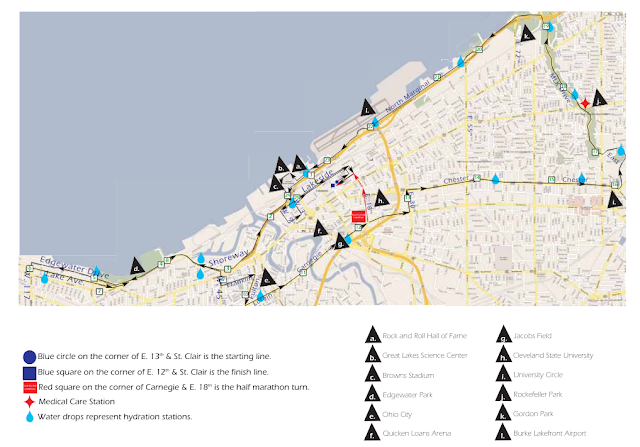
The start is at the corner of East 13th and St. Clair Avenue, and the initial direction is eastbound. Within a half-mile, you will turn north and then west. At East 9th Street, you turn north and quickly west. You’re now on Lakeside Avenue.


Here, just past the one-mile mark, you pass three landmarks in succession: the Rock and Roll Hall of Fame and Museum, the Great Lakes Science Center and Browns Stadium. You may catch a glimpse of Lake Erie in between. The Rock Hall is a stunning piece of architecture, designed by I. M. Pei. The Great Lakes Science Center is a hands-on science museum. Browns Stadium will be quiet, but things change just a bit on Autumn Sundays.


Continuing westward, at mile 2 you will cross the Detroit-Superior Bridge over the Cuyahoga River and the Flats. Yes, this is the river that caught fire in the 1960s. And yes, it’s much cleaner now, as is Lake Erie, into which it flows. Along the river below is the Flats, formerly a lively area of bars, restaurants and music venues, but currently undergoing a major rebuilding project. From the bridge, you can see the confluence of the river and the lake by looking to your right. You’ll also see many other bridges of all shapes and sizes. Enjoy the whole scene.


Now you’re on the west side of town. Clevelanders consider the city’s east and west sides to be almost like different cities. After mile 3 you will go down a hill towards Edgewater Park, which you will reach by Mile 4. The park includes beaches along the lake, and is also quite scenic. The beach will be quiet on an early Sunday morning in May, but come back to check it out in the summer.


You will continue westbound on Edgewater Drive, past some beautiful lakeside homes, as you approach the 6-mile mark. Here, at West 117th Street, you will turn south and then quickly back east on Lake Avenue. By about Mile 8, you’re heading back past Edgewater Park and eventually back up the hill that took you down there. This hill is not extremely steep, but it is fairly long, and is enough to slow you down a bit.


At mile 9 the course takes some turns: south on West 45th Street, east on Franklin, south on Fulton and then east on Lorain. This is the Ohio City neighborhood. You’ll pass St. Ignatius High School, famous for both sports and academics, and the Franklin Castle, which is boarded up and supposedly haunted. You’ll also pass the West Side Market, a Mecca for shoppers of ethnic meats as well as produce and other foods. It’s not on the Must See list, but it may be worth a stop on Saturday, just to witness the spectacle.


Lorain changes to Carnegie as you once again cross over the Cuyahoga River via the Hope Memorial Bridge and continue eastbound. On the Bridge, which is named for William Henry Hope, a local stonemason and father of Bob Hope, check out the two sets of huge iconic “Guardians of Traffic” statues at each end. Coming off the bridge you will pass Jacobs Field, home to the Cleveland Indians, as well as Quicken Loans Arena, aka the Q, home to the Cleveland Cavaliers.


Spectators who were downtown for the start may have been able to watch the runners come by after the early turns and may now be able to walk a few blocks to see the runners approach downtown once again. Soon after Mile 12, the half-marathoners peel off to the left to finish their race. Suddenly, you’re running with fewer companions, and you realize that this marathon stuff is serious business.


Just past Cleveland State University, you will turn north onto East 30th Street, and then East once again on Chester Avenue. You will be on Chester for about three miles. The avenue is wide and the residential neighborhoods are quiet here. It is mostly flat with a few very gently rolling hills. You will pass the famous Cleveland Clinic to the right. It takes up several blocks and is continuously expanding.


At about mile 16, the course turns north into and around University Circle. This area is home to Case Western Reserve University, University Hospitals, Severance Hall (home of the world-renowned Cleveland Orchestra), and several acclaimed museums. After the Circle, you will turn right to continue north on Martin Luther King Drive. Now you’re running through Rockefeller Park, one of the prettiest parts of the course. While traversing the park, notice the various national gardens along the way. The course winds through this shady, wonderfully scenic park for a couple miles until you reach Lake Erie.


Mile 19 is in Gordon Park, where the course turns back to the west, along the lake. You will now be mostly along the lake, on bike paths and North Marginal Road, until you’re past the 23-mile mark. You may see fishermen along the shore here and for the next few miles. The lake has many moods: calm and blue, slate gray, choppy, or just plain angry. Most of these moods won’t affect you, other than to be a source of fascination. One thing that will affect you, though, is the wind. It would be nice to say that you can get a nice tailwind here to carry you to a PR, but don’t count on it! It is more likely to be in your face, but it is quite unpredictable, so close to the lake itself. Your best bet is to plan for this part to be tough but enjoyable nonetheless.


After mile 23, you will once again pass near the Rock Hall, Great Lakes Science Center, and Browns Stadium, before heading back to the downtown area. On West 3rd Street you will go up a short but nasty (mostly because it is 24 miles into your run) hill. At the top, you’ll turn west and then south again on West 9th. You’re in the Warehouse District, now popular residential area with several trendy restaurants. Another turn back to the east, and you’re going through the Public Square area, the center of town. By mile 25, you’re heading eastward on Lakeside, back towards the finish. You will turn south and then westbound once more, for about the last ¼ mile, to finish at East 12th and St. Clair.


There now. Wasn’t that fun? Get some refreshments, get your gear, and enjoy the entertainment. You deserve it!


Runner’s Highs / Runner’s Lows


Highs


Fast course – not entirely flat, but fast nonetheless

Generally good marathon weather, although not always

Some great scenery, including Lake Erie, Rockefeller Park and the University Circle area

Convenient start and finish locations

Music stations and cheering sections along the course


Lows


Finish area is congested and sometimes blocks runners from re-entry after they retrieve their clothes.

The wind along the Lake Erie shore can be brutal at times.


Must See / Must Avoid


Must See


Rock and Roll Hall of Fame and Museum. This is one of Cleveland’s top attractions with good reason. Established in 1995, it is the home for the celebration and study of rock and roll music. The exhibits, educational programs and performance events have made it a draw for both fans and artists. The Rock Hall also became more involved with the Marathon in 2007, sponsoring an aid station and providing discounts to runners.


Cleveland Orchestra and other performing arts. The orchestra is renowned as one of the best on the planet. They play at historic Severance Hall in the University Circle area. Don’t miss this opportunity to hear classical music at its best. Cleveland also has a great theater scene, with much of the activity at Playhouse Square, just east of downtown.


Parks. The Cleveland area is blessed with beautiful parks of all kinds. The Emerald Necklace forms a partial ring around the city, where parks are linked to one another with greenways. These and other Cleveland Metroparks offer miles of scenic wooded areas with trails galore. Also nearby is Cuyahoga Valley National Park, including more great scenery and woods as well as the Ohio and Erie Canal Towpath, home of the Towpath Marathon.


Lake Erie. There are several options here. Beaches include Huntington and Edgewater west of the city center, and Headlands far to the east. The Goodtime III takes a short cruise on the lake and the Cuyahoga River, and at various times includes dinner and dancing. If you have more time, you can also travel to some of the Lake Erie Islands by boat from the Sandusky area an hour or so west of the city.


Cedar Point. This attraction, also in the Sandusky area is home of the most, as well as some of the fastest, highest, and most exciting roller coasters in the world. It is usually open during weekends in May. It’s well worth the trip, especially if you’ve got smaller family members along with you.


Must Avoid


Bad guys. Like any large city, Cleveland is generally safe, but there are some areas with more crime than others. Most of downtown is ok. Just exercise caution when you’re about, especially at night. It’s best to be with others whenever possible.


The Cleveland Clinic. This institution is widely recognized as one of the best hospitals anywhere, but please don’t wind up here as a result of your efforts in the race!


The Basics


The Rite Aid Cleveland Marathon

29525 Chagrin Blvd., Suite 215

Pepper Pike, OH 44122


Phone: 800-467-3826


FAX: 216-378-0413


Web Site: www.clevelandmarathon.com


e-mail: clevelandmarathon@earthlink.net


Events:

  • Expo

  • Pasta Dinner

  • Children’s Fun Run

  • Marathon run and walk

  • Half-Marathon run and walk

  • 10-K Run and walk


Executive Race Director: Jack Staph

Race Director: Ralph Staph


Year Race Established: 1978


Future Race Date: 18 May, 2008 (usually the 3rd Sunday in May)


Start Time: 7:00 AM


Course Records:

  • Women: 2:30:15 - Tatiana Pozdniakova, 1998

  • Men: 2:10:29 - Pavel Kokin, 2000


Awards:

  • Total purse: $6,200 (marathon only)

  • Male and Female Winners: $1,000

  • Other prize money to:

    • 2nd through 5th place Male and Female

    • Top 3 masters

    • Walkers

  • Other awards to top 5 in each age group


Number of Volunteers: about 1,500


Finishers in 2007:

Marathon Runners: 1,925

Half-Marathon Runners: 2,913

10K Runners: 2,649

Marathon Walkers: 62

Half-Marathon Walkers: 280

10K Walkers: 444

Wheelchair Racers (multiple divisions): 24


Male/Female Marathon Finishers: 66% Male; 34% Female


Course Markings: Every mile


Aid Stations: 18-19


Entry Fees: $65 to $95


Host Hotel:

Hyatt Regency Cleveland at the Arcade, 800-233-1234

Other Hotels:

Renaissance Cleveland Hotel, 800-468-3571

Crowne Plaza Hotel, 800-321-1090


Travel:

Cleveland Hopkins Airport is located southwest of downtown and is served by several large airlines.

If you are driving, Cleveland is served by Interstate Highways I90, I71 and I77. I80 and connecting interstates are also nearby.


The good, the bad, and the slugly

The Good

It wasn't too long ago that I began to be concerned that my old Achilles tendonitis might be rearing its ugly head once again. Then I came up with a hopeful theory that the pain was entirely due to a callus that had developed on the incision scar. Today I am pleased to report that the callus remover appears to have worked. Part of the callus came off by itself after using the stuff. Doctor Debbie Horvath then took a scalpel to the rest of it. Now I use moleskin for some extra padding, but the pain is pretty much gone.

But wait, there's more good news. On occasion, I run fairly well. Not fantastic. Just pretty good. Better than a few weeks ago. Will it be good enough to run a good marathon next week? Nah. But maybe I'll be able to run a marathon next week. (Note the missing qualifier in that last sentence.)


The Bad

The coffee didn't work today. This is only the one-zillionth time for me. I started my run slow, and ...


The Slugly

And instead of getting into the groove, I only got sleepier and slower. They can't all be gems.

Tuesday, May 07, 2024

My dream/nightmare

Today's track workout was to be the one where we run ten 400s with 100-meter recoveries to add up to 5,000 meters, in total. It's a good gut check for the 5K distance - you're running the 400s at about your 5K speed, but you get breaks between each lap. Adding it all up today, I ran my 5K a minute and a half faster than I did for the Run 4 Fun. Sounds pretty good, eh?

It's fine. Except for one thing: I'm not training for a 5K; I'm training for a marathon. Yes, Cleveland is only a week and a half away. 

Ever have that familiar old dream/nightmare where you are in college and about to take a final exam but only now realize that you haven't attended class, studied, or even opened the book for the entire term? That about sums up my thoughts for this upcoming race. It's mostly because I haven't been doing Yassos. I never do not do Yassos. All of this was bouncing around my head during this morning's pre-workout panic attack.

How to empty my head of such negative thoughts? How about adding enough speedy laps such that the total adds up to the length of a Yasso Workout? That means five 800s at the tail end of the ten 400s. When everyone else was done and headed home. This time it worked. I did an early 800, followed by the ten 400s, followed by four more 800s. Sure enough, it was the same amount of speedy laps as if I'd just done Yassos.

Saturday, May 04, 2024

Medina Run4Fun Race Report

It's a 5K (not my best distance). It's in the evening (I am a morning person.). I've already had my run today. I ran long yesterday. I'm not feeling all that well anyway (for several reasons). Yes, you could say that I'm out of my comfort zone. Just jog it, I say to myself. You can make the distance. Maybe.

But this is a fun little 5K race. You can tell, because 'fun' is in the name. There is a track meet going on as I arrive. I watch some of the running there in the stadium. I then jog around and see lots of other kids coming and going. The lacrosse kids are preparing to take the field after the track meet and the kids' 800-meter run.

The 5K is mostly kids as well. I suppose that since the race benefits the schools, the parents who organize it entice their children to participate as well. I'm a little surprised that, besides Harold Dravenstott and Sharon Sibilski, I don't see more of my regular running friends. That's okay; they wouldn't want to see me run so poorly anyway. I know I sure don't.

I ran this race two years ago, and probably a few times before that. This feels about the same. I line up in back and start with Harold. We watch as Sharon starts a little faster and moves up ahead. HD and I run together for a while, but I pull ahead for the final mile or so. I guess we won't be having a race to the death today. The pace (9:00 to 9:15 per mile) is slower than I would have liked, but at least it's steady.

My time is 27:48 or so. I hope I can take a few minutes off that time as the season progresses. Maybe I can eliminate at least some of those excuses. And get back into my comfort zone.

Allow me to summarize my feelings a different way. I hate 5Ks. And I need to do more of them.

Friday, May 03, 2024

Uranus is in the wrong place

 Oh, the things Dan says.

"It's the Journey of Gnatty Dan." Debbie Hicks, Shannon Barnes, Harold Dravenstott, and I had begun at Medina Square, and promptly encountered clouds of gnats as we turned onto the Champion Creek Multipurpose Trail. They got in our eyes, noses, mouths, and everywhere else you can think of.

"Uranus is in the wrong place." The Helios Project was installed last year. Models of the sun, the planets, and non-planet Pluto are placed along the park trail and the size and relative distance of the objects are to scale. The distance between Jupiter and Saturn appears to be much greater than that from Saturn to Uranus, Neptune, and Pluto. I mentioned that this didn't seem right; the distance between the planets keeps increasing with their distance from the sun. So Uranus should be placed much farther away. When I got home, I looked it up. I was right; to keep the scale correct, Uranus would be at the very end of the trail, and Neptune and Pluto would be farther still. There. I think I got through that without even one Uranus joke. 


"Debbie used to teach math, but now she's history." After many fine years as a teacher, Debbie is about to retire. I mentioned that her coworkers would soon be able to honestly say this. My running friends ask, "How long did it take you to come up with that one, Dan?" "Not long enough," I answer.

Thursday, May 02, 2024

Something Wonderful

I am nearly ten miles into my planned twenty-miler. It's taken me two full hours to get this far, and any hopes of having a good, solid long run seem to be out the window. I had started slowly and I've done nothing but get even slower. The only idea I've been able to come up with is to head over to Brunswick Lake and do multiple one-mile lake loops. To get there, I'm headed around and in back of Brunswick High School. I glance over at the track, and it's open. Let me repeat that. It's OPEN!

This almost never happens. They keep the track closed up tighter than the Pentagon. I haven't been able to run here in about a year. It's often frustrating, but then, I'm so much more full of joy when things do actually work out here. I wrote a post about all this back in 2015. Probably some other ones too. Now, I will be able to run most of my remaining miles here today.

And I do. And the pace improves. And my demeanor improves as well. I go from 12-minute miles to 9:40 and better ones. Each mile gets faster from 11 through 17 when it's time to run the three miles back home. Even those miles aren't bad, and mile 20, my last, turns out to be the fastest mile of the day.

You've heard it here before: all's well that ends well. It's true again today.